Quick Answer
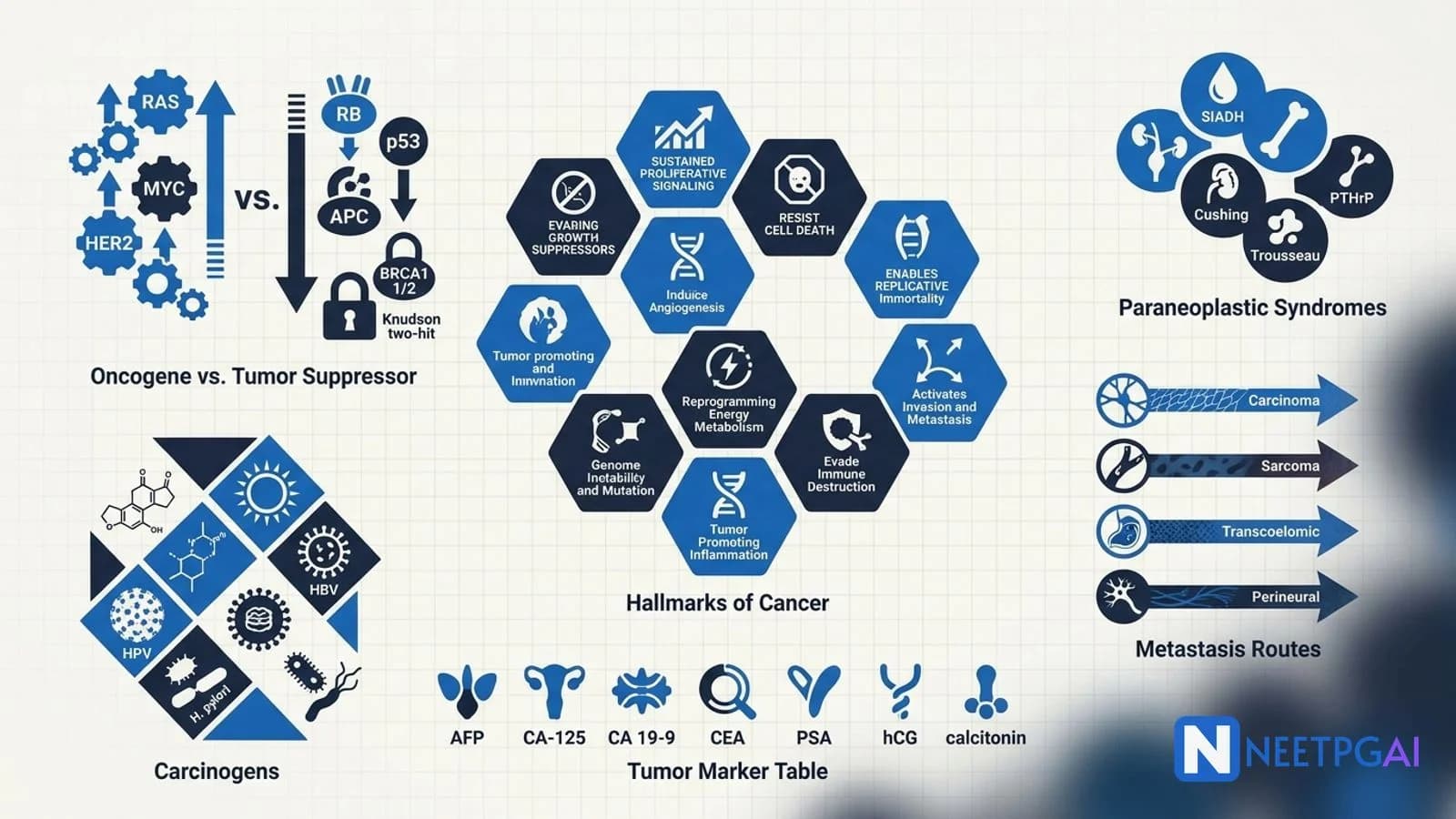
Neoplasia is the highest-weight general pathology chapter in NEET PG, and roughly 12 to 15 marks depend on nailing carcinogenesis, hallmarks, tumor markers and paraneoplastic syndromes. Master these seven anchors.
- Nomenclature — benign (-oma), malignant epithelial (carcinoma), malignant mesenchymal (sarcoma), blood (leukemia, lymphoma, myeloma), germ cell (teratoma, seminoma), embryonic (blastoma).
- Grade vs stage — grade is microscopic differentiation; stage is anatomic extent (TNM). Stage matters more prognostically.
- Hallmarks of cancer — 6 classical + 2 enabling + 2 emerging (Hanahan and Weinberg).
- Oncogenes (RAS, MYC, HER2, BCR-ABL, EGFR) — gain of function, dominant, single hit. Tumor suppressors (RB, p53, APC, BRCA1/2, VHL) — loss of function, recessive, two-hit hypothesis.
- Carcinogens — chemical (aflatoxin, nitrosamines, vinyl chloride, asbestos), physical (UV, ionising radiation), biological (HPV, HBV/HCV, EBV, HHV-8, HTLV-1, H. pylori).
- Tumor markers — AFP, CEA, CA 125, CA 19-9, PSA, hCG, LDH, calcitonin, thyroglobulin, chromogranin, VMA/HVA, 5-HIAA, ferritin.
- Paraneoplastic — SIADH and ectopic ACTH (small cell lung), PTHrP hypercalcaemia (SCC lung), erythrocytosis (RCC, HCC), Trousseau (pancreatic), Lambert-Eaton (small cell).
Neoplasia dominates general pathology in NEET PG for one simple reason — India is now the world's third-highest cancer burden country with more than 1.4 million new cases per year, and every clinical branch tests oncological pattern recognition. Whether it is a lung mass with hyponatraemia (small cell + SIADH), a right-lobe liver lesion in a hepatitis B carrier (HCC + AFP), or a jaw mass in a child (Burkitt + EBV + t(8;14) MYC), the same molecular vocabulary keeps repeating.
This NEETPGAI deep dive covers nomenclature, hallmarks, oncogenes and tumor suppressors, viral and chemical carcinogens, tumor markers, metastasis routes and paraneoplastic syndromes — with the India-specific context (HPV cervical burden, tobacco oral cancer, PMJAY oncology coverage) that examiners love. Pair it with the cell injury and necrosis guide for the upstream cellular events cancer subverts.
Nomenclature — how to name any tumor
Neoplasia is a "new growth" that persists after the stimulus that provoked it is removed. Benign tumors stay localised; malignant tumors invade and metastasise.
| Cell of origin | Benign | Malignant |
|---|
| Squamous epithelium | Squamous papilloma | Squamous cell carcinoma |
| Glandular epithelium | Adenoma | Adenocarcinoma |
| Transitional epithelium | Urothelial papilloma | Urothelial carcinoma |
| Fibrous tissue | Fibroma | Fibrosarcoma |
| Adipose tissue | Lipoma | Liposarcoma |
| Cartilage | Chondroma | Chondrosarcoma |
| Bone | Osteoma | Osteosarcoma |
| Blood vessels | Haemangioma | Angiosarcoma |
| Smooth muscle | Leiomyoma | Leiomyosarcoma |
| Skeletal muscle | Rhabdomyoma | Rhabdomyosarcoma |
| Nerve sheath | Schwannoma, neurofibroma | Malignant peripheral nerve sheath tumor |
| Melanocyte | Naevus | Melanoma |
| Germ cell | Mature teratoma, dermoid cyst | Seminoma, dysgerminoma, choriocarcinoma, yolk sac, embryonal carcinoma, immature teratoma |
| Embryonic (children) | — | Blastomas — Wilms (nephroblastoma), neuroblastoma, retinoblastoma, hepatoblastoma, medulloblastoma |
| Haematopoietic | — | Leukemia, lymphoma, multiple myeloma |
Exceptions to the -oma benign rule — lymphoma, melanoma, seminoma and hepatoma are all malignant despite the -oma suffix.
Grade vs stage
- Grade — degree of differentiation on microscopy (well, moderately, poorly, undifferentiated). Reflects biological aggressiveness. Systems include Bloom-Richardson (breast), Gleason (prostate), Furhman (renal).
- Stage — anatomic extent using TNM (tumor size and local invasion, regional lymph nodes, distant metastasis). Stage matters more prognostically than grade for most solid tumors.
Hallmarks of cancer
Hanahan and Weinberg described six classical hallmarks, two enabling characteristics and two emerging hallmarks. Each maps to specific molecular events.
- Self-sufficiency in growth signals — RAS activation, HER2 amplification, EGFR mutation, autocrine PDGF loops.
- Insensitivity to anti-growth signals — RB loss, TGF-beta pathway defects.
- Evasion of apoptosis — p53 mutation (loss of intrinsic pathway), BCL2 overexpression (follicular lymphoma t(14;18)), FAS pathway defects.
- Limitless replicative potential — reactivation of telomerase (TERT promoter mutation).
- Sustained angiogenesis — VEGF overexpression; the target of bevacizumab.
- Tissue invasion and metastasis — loss of E-cadherin (gastric lobular, breast lobular), MMP overexpression, epithelial-mesenchymal transition (EMT).
- Genome instability (enabling) — chromosomal instability, microsatellite instability (mismatch repair defects — Lynch syndrome).
- Tumor-promoting inflammation (enabling) — chronic inflammation driving mutation (H. pylori, HBV/HCV, ulcerative colitis).
- Deregulated metabolism (emerging) — Warburg effect, aerobic glycolysis; the basis of FDG-PET imaging.
- Immune evasion (emerging) — PD-L1 upregulation, MHC I downregulation; the target of checkpoint inhibitors (pembrolizumab, nivolumab).
Molecular basis — oncogenes and tumor suppressors
Oncogenes (single-hit gain of function)
| Gene | Function | Classical cancer |
|---|
| RAS | GTPase signalling | Colon, pancreas, lung — the most commonly mutated oncogene in human cancer |
| MYC | Transcription factor | Burkitt lymphoma (t(8;14) IgH-MYC) |
| HER2 (ERBB2) | Receptor tyrosine kinase | Breast (targeted by trastuzumab) |
| BCR-ABL | Fusion tyrosine kinase | CML (t(9;22) Philadelphia chromosome; targeted by imatinib) |
| EGFR | Receptor tyrosine kinase | Lung adenocarcinoma (targeted by gefitinib, erlotinib) |
| BCL2 | Anti-apoptotic | Follicular lymphoma (t(14;18) IgH-BCL2) |
| CYCLIN D1 | Cell cycle | Mantle cell lymphoma (t(11;14)) |
| PML-RARA | Fusion transcription factor | Acute promyelocytic leukemia t(15;17); treated with ATRA |
| RET | Receptor tyrosine kinase | MEN 2A, MEN 2B, medullary thyroid carcinoma |
| KIT | Receptor tyrosine kinase | GIST, mastocytosis (targeted by imatinib) |
| BRAF | Serine-threonine kinase | Melanoma, hairy cell leukemia, colorectal (targeted by vemurafenib) |
Tumor suppressor genes (two-hit loss of function)
| Gene | Function | Syndrome / cancer |
|---|
| RB | Cell cycle at G1/S | Retinoblastoma (hereditary and sporadic); Knudson original two-hit gene |
| p53 | DNA damage response, apoptosis | Li-Fraumeni syndrome (sarcomas, breast, brain, adrenal cortex); the most commonly mutated gene in human cancer overall |
| APC | Wnt/beta-catenin regulation | Familial adenomatous polyposis; colorectal cancer |
| BRCA1 and BRCA2 | Homologous recombination DNA repair | Hereditary breast and ovarian cancer (BRCA1 also triple-negative breast, BRCA2 also male breast, pancreas, prostate) |
| VHL | HIF degradation | Von Hippel-Lindau syndrome (haemangioblastoma, RCC clear cell, phaeochromocytoma) |
| NF1 | RAS-GAP | Neurofibromatosis 1 (cafe-au-lait, neurofibromas, optic gliomas) |
| NF2 | Cytoskeletal linker | Neurofibromatosis 2 (bilateral vestibular schwannomas) |
| WT1 | Transcription factor | Wilms tumor |
| DCC and SMAD4 | TGF-beta signalling | Colorectal cancer |
| MLH1, MSH2, MSH6, PMS2 | Mismatch repair | Lynch syndrome (HNPCC); microsatellite instability |
| PTEN | PI3K/Akt inhibition | Cowden syndrome (breast, thyroid, endometrium) |
| STK11 (LKB1) | Kinase | Peutz-Jeghers (mucocutaneous pigmentation, hamartomatous GI polyps) |
Chemical, physical and biological carcinogens
Chemical carcinogens
| Agent | Cancer | Molecular note |
|---|
| Aflatoxin B1 (Aspergillus flavus on stored grains) | Hepatocellular carcinoma | p53 codon 249 mutation (India-relevant) |
| Nitrosamines (smoked meat) | Gastric carcinoma | Japan and India northeast belt |
| Vinyl chloride | Hepatic angiosarcoma | PVC industry |
| Aromatic amines (beta-naphthylamine) | Urothelial (bladder) carcinoma | Dye and rubber industry |
| Asbestos | Malignant mesothelioma, bronchogenic carcinoma | Long latency (20 to 40 years) |
| Benzene | Acute leukemia | Petroleum, solvents |
| Alkylating agents (cyclophosphamide) | Therapy-related AML/MDS | Latency 5 to 10 years |
| Tobacco (smoked and smokeless) | Lung, oral, laryngeal, oesophageal, bladder, pancreatic, cervical | Massive India oral cancer burden with gutka and pan masala |
| Alcohol | Head and neck, oesophageal, hepatocellular, colorectal, breast | Synergistic with tobacco |
| Arsenic (contaminated groundwater) | Skin, lung, bladder | West Bengal and Bangladesh belt |
Physical carcinogens
- UV radiation — basal cell carcinoma, squamous cell carcinoma, melanoma; xeroderma pigmentosum is defective nucleotide excision repair.
- Ionising radiation — thyroid papillary carcinoma (children), leukemia (except CLL), breast, lung; Hiroshima and Chernobyl cohorts.
- Chronic irritation — Marjolin ulcer (SCC in burn scars, chronic osteomyelitis sinuses).
Biological carcinogens
- HPV — high-risk 16, 18, 31, 33; cervical, anal, oropharyngeal, penile, vulvar SCC. E6 degrades p53, E7 inactivates RB. Vaccines Cervavac (Indian quadrivalent), Gardasil-9.
- HBV, HCV — hepatocellular carcinoma via chronic inflammation and cirrhosis; India has ~40 million HBV carriers.
- EBV — Burkitt lymphoma (endemic African jaw form, sporadic abdominal), Hodgkin lymphoma (mixed cellularity in HIV), nasopharyngeal carcinoma (Southeast Asian), post-transplant lymphoproliferative disease, primary CNS lymphoma in AIDS.
- HHV-8 — Kaposi sarcoma in AIDS.
- HTLV-1 — adult T-cell leukemia/lymphoma (endemic Japan, Caribbean).
- Merkel cell polyomavirus — Merkel cell carcinoma.
- H. pylori — gastric adenocarcinoma and gastric MALT lymphoma (MALToma often regresses with H. pylori eradication).
- Schistosoma haematobium — bladder SCC (Egypt).
- Clonorchis sinensis, Opisthorchis — cholangiocarcinoma (Southeast Asia).
Familial cancer syndromes
- Li-Fraumeni — germline p53; sarcomas, breast, brain, leukemia, adrenal cortex before 45.
- Lynch (HNPCC) — MMR gene mutations; colorectal (right-sided), endometrial, ovarian, urothelial. Amsterdam and Bethesda criteria for screening.
- FAP — APC mutation; hundreds of colonic polyps by age 20, near-certain colorectal cancer by 40 if untreated.
- BRCA1 and BRCA2 — breast and ovarian cancer risk; BRCA1 also triple-negative breast, BRCA2 also male breast, pancreas, prostate. Prophylactic mastectomy and salpingo-oophorectomy discussed after genetic counselling.
- MEN 1 — parathyroid + pancreatic (gastrinoma, insulinoma) + pituitary; MEN1 gene.
- MEN 2A — medullary thyroid + phaeochromocytoma + parathyroid; RET.
- MEN 2B — medullary thyroid + phaeochromocytoma + mucosal neuromas + marfanoid habitus; RET.
- Retinoblastoma — RB1; leukocoria in a child; hereditary form is bilateral and associated with second primary osteosarcoma.
- Neurofibromatosis 1 — NF1; cafe-au-lait spots (six or more, more than 1.5 cm postpubertal), Lisch nodules, axillary and inguinal freckling, optic pathway glioma.
- Neurofibromatosis 2 — NF2; bilateral vestibular schwannomas, meningiomas, ependymomas.
- Peutz-Jeghers — STK11; mucocutaneous pigmentation, hamartomatous GI polyps, intussusception, increased cancer risk.
- VHL — cerebellar and retinal haemangioblastomas, clear cell RCC, phaeochromocytoma, pancreatic serous cystadenomas.
- Cowden — PTEN; breast, thyroid, endometrium; mucocutaneous hamartomas.
Tumor markers — the exam checklist
| Marker | Cancer | Clinical use |
|---|
| AFP | Hepatocellular carcinoma, yolk sac germ cell | Screening in HBV/HCV cirrhosis (with ultrasound) |
| CEA | Colorectal, also breast, pancreatic, gastric | Recurrence monitoring after colorectal resection |
| CA 125 | Ovarian epithelial | Monitoring, not screening (raised in endometriosis, PID, pregnancy) |
| CA 19-9 | Pancreatic, biliary | Monitoring; needs Lewis antigen positivity |
| CA 15-3, CA 27-29 | Breast cancer | Metastatic monitoring |
| PSA | Prostate | Screening (controversial), recurrence monitoring |
| hCG | Choriocarcinoma, gestational trophoblastic disease, seminoma with syncytiotrophoblasts | Diagnosis and monitoring |
| LDH | Germ cell tumors, lymphoma | Non-specific; correlates with tumor bulk |
| Calcitonin | Medullary thyroid carcinoma, MEN 2 | Diagnosis and monitoring |
| Thyroglobulin | Differentiated thyroid carcinoma post-thyroidectomy | Follow-up |
| Chromogranin A | Neuroendocrine tumors, carcinoid, phaeochromocytoma | Diagnosis |
| VMA, HVA (urinary) | Neuroblastoma, phaeochromocytoma | Diagnosis in children |
| 5-HIAA (urinary) | Carcinoid syndrome | Diagnosis |
| Ferritin | HCC, neuroblastoma | Non-specific |
| Bence Jones protein | Multiple myeloma | Free light chains in urine |
| Beta-2 microglobulin | Multiple myeloma, CLL | Staging and prognosis |
Metastasis — routes and destinations
- Direct (contiguous) — ovarian cancer to peritoneum, pancreatic head to duodenum.
- Lymphatic — the predominant route for carcinomas; regional nodes first, then distant. Virchow node (left supraclavicular) — gastric cancer. Sister Mary Joseph nodule — umbilical metastasis from gastric or ovarian.
- Haematogenous — the predominant route for sarcomas; also carcinomas with vascular invasion (renal cell, hepatocellular, follicular thyroid, choriocarcinoma). Common destinations: lung, liver, brain, bone.
- Transcoelomic — spread across body cavities; ovarian to peritoneum, gastric to ovary (Krukenberg tumor with signet-ring cells).
- Perineural — pancreatic adenocarcinoma, adenoid cystic carcinoma.
- CSF seeding — medulloblastoma, ependymoma, glioblastoma.
Bone metastasis pattern — most cancers are osteolytic (breast, lung, thyroid, kidney, GI, multiple myeloma). Notable osteoblastic metastases — prostate cancer and, sometimes, breast cancer. Mnemonic for common bone metastasis primaries — "BLT KP" — Breast, Lung, Thyroid, Kidney, Prostate.
Paraneoplastic syndromes
- Small cell lung carcinoma — SIADH (ectopic ADH, hyponatraemia), ectopic ACTH (Cushing with hypokalaemic alkalosis, without classical stigmata), Lambert-Eaton myasthenic syndrome (anti-VGCC), subacute cerebellar degeneration (anti-Yo, anti-Hu), limbic encephalitis.
- Squamous cell lung carcinoma — PTHrP-induced hypercalcaemia of malignancy.
- Renal cell carcinoma and hepatocellular carcinoma — erythrocytosis from ectopic erythropoietin.
- Pancreatic adenocarcinoma — Trousseau syndrome (migratory superficial thrombophlebitis).
- Carcinoid tumor with liver metastases — flushing, diarrhoea, bronchospasm, right-sided cardiac valve fibrosis (tricuspid regurgitation, pulmonary stenosis) — 5-HIAA raised in urine.
- Cutaneous — acanthosis nigricans (gastric adenocarcinoma), dermatomyositis (ovarian, breast, lung, GI cancers), Leser-Trelat sign (sudden appearance of multiple seborrheic keratoses — visceral malignancy), erythroderma.
- Hypertrophic osteoarthropathy — clubbing, periostitis, arthritis; classic in lung malignancy.
India-specific and NEET PG traps
- Cervical cancer — India accounts for roughly one-fifth of the global cervical cancer burden; HPV 16 and 18 predominant; Cervavac vaccine national roll-out.
- Oral cancer — highest incidence in India globally due to gutka, khaini, tobacco chewing; buccal mucosa most common site; verrucous carcinoma with Ackerman variant.
- Breast cancer — now overtaken cervical to become the commonest cancer in Indian women; younger age at presentation than West.
- Gastric cancer — high in Kashmir and northeast belt (nitrosamines, smoked food); H. pylori link.
- Aflatoxin HCC — stored grains under monsoon humidity; p53 codon 249 mutation is Indian and African high-yield.
- Retinoblastoma — India has one of the largest paediatric ophthalmic oncology programmes globally; leukocoria in a child under 3 needs urgent referral.
- CML — the paradigm targeted-therapy success; imatinib against BCR-ABL Philadelphia chromosome t(9;22).
- Burkitt lymphoma — t(8;14) MYC-IgH; endemic African form (jaw mass in a child, EBV positive) versus sporadic (abdominal, less EBV linked).
- APL (M3) — t(15;17) PML-RARA; treat with ATRA (all-trans retinoic acid) plus arsenic trioxide; DIC risk on presentation.
- BRCA1 — triple-negative breast cancer often; discuss prophylactic mastectomy and salpingo-oophorectomy after counselling.
- Lynch syndrome (HNPCC) — right-sided colon cancer, endometrial, ovarian, urothelial; MMR mutations; MSI-high tumors respond to checkpoint inhibitors.
- Warburg effect — aerobic glycolysis; basis of FDG-PET imaging.
- Trousseau syndrome — pancreatic adenocarcinoma classic.
- Krukenberg tumor — bilateral ovarian metastases from gastric signet-ring adenocarcinoma via transcoelomic spread.
- Virchow node — left supraclavicular from gastric cancer.
- Sister Mary Joseph nodule — umbilical metastasis from gastric or ovarian primary.
- Signet-ring cells — gastric diffuse type (poor prognosis), also breast lobular.
- Psammoma bodies — laminated calcifications in papillary thyroid, serous ovarian cystadenocarcinoma, meningioma, mesothelioma.
- Homer Wright rosettes — neuroblastoma, medulloblastoma. Flexner-Wintersteiner rosettes — retinoblastoma.
- PMJAY oncology coverage — Ayushman Bharat covers cancer packages; National Cancer Grid and regional cancer centres (Tata Memorial, RGCI, AIIMS oncology) drive Indian care; NCRP registry captures incidence.
Frequently asked questions
What is the difference between an oncogene and a tumor suppressor gene?
An oncogene is the mutated, over-active form of a normal proto-oncogene that promotes cell growth. It is dominant at the cellular level — a single hit on one allele produces a gain of function that drives uncontrolled proliferation. Classic examples are RAS (colon, pancreas, lung), MYC (Burkitt lymphoma t(8;14)), HER2 (breast), BCR-ABL (CML t(9;22)) and EGFR (lung adenocarcinoma). A tumor suppressor gene normally restrains cell growth or triggers apoptosis. It is recessive at the cellular level — both alleles must be inactivated for loss of function, described by Knudson two-hit hypothesis. Classic examples are RB (retinoblastoma), p53 (Li-Fraumeni, most commonly mutated gene in cancer), APC (familial adenomatous polyposis), BRCA1 and BRCA2 (breast and ovarian), VHL, NF1 and NF2. Both mechanisms converge on deregulated cell cycle control.
What are the eight hallmarks of cancer described by Hanahan and Weinberg?
The six classical hallmarks are self-sufficiency in growth signals (RAS activation), insensitivity to anti-growth signals (RB loss), evasion of apoptosis (p53 loss, BCL2 overexpression), limitless replicative potential (telomerase reactivation), sustained angiogenesis (VEGF) and tissue invasion plus metastasis. Two enabling characteristics — genome instability (mismatch repair defects, chromosomal instability) and tumor-promoting inflammation — were added. Two emerging hallmarks are deregulated cellular metabolism (Warburg effect, aerobic glycolysis) and immune evasion (PD-L1 upregulation, MHC I downregulation). NEET PG stems commonly ask which hallmark matches which molecular event — for instance, RB loss corresponds to insensitivity to anti-growth signals and telomerase reactivation corresponds to limitless replicative potential.
Which viruses cause human cancers and which cancers do they cause?
The major oncogenic viruses are: HPV — cervical, anal, oropharyngeal, penile and vulvar squamous cell carcinoma; high-risk types 16 and 18 (E6 degrades p53, E7 inactivates RB). HBV and HCV — hepatocellular carcinoma via chronic inflammation and cirrhosis. EBV — Burkitt lymphoma (t(8;14) MYC translocation, endemic African jaw form), nasopharyngeal carcinoma (Southeast Asian), Hodgkin lymphoma, post-transplant lymphoproliferative disease (PTLD), primary CNS lymphoma in AIDS. HHV-8 — Kaposi sarcoma in AIDS. HTLV-1 — adult T-cell leukemia/lymphoma. Merkel cell polyomavirus — Merkel cell carcinoma. Parasites also cause cancer — Schistosoma haematobium causes squamous cell carcinoma of the bladder in Egypt and Clonorchis sinensis causes cholangiocarcinoma in Southeast Asia. Helicobacter pylori causes gastric MALT lymphoma and gastric adenocarcinoma.
What are the most important tumor markers and what cancers do they suggest?
AFP (alpha fetoprotein) — hepatocellular carcinoma and yolk sac germ cell tumors; also raised in pregnancy, hepatitis. CEA (carcinoembryonic antigen) — colorectal cancer, useful for recurrence monitoring after surgery; also raised in smokers. CA 125 — ovarian epithelial cancer; also raised in endometriosis, peritonitis and pregnancy. CA 19-9 — pancreatic and biliary cancer; needs Lewis antigen positivity to be produced. PSA — prostate cancer screening and recurrence, though controversial due to overdiagnosis. hCG — germ cell tumors (choriocarcinoma, seminoma with syncytiotrophoblastic cells) and gestational trophoblastic disease. LDH — germ cell tumors, lymphoma; nonspecific marker of turnover. Calcitonin — medullary thyroid carcinoma, MEN 2. Thyroglobulin — differentiated thyroid cancer follow-up after total thyroidectomy. Chromogranin A — neuroendocrine tumors. VMA and HVA (urinary) — neuroblastoma and phaeochromocytoma. 5-HIAA (urinary) — carcinoid syndrome. Ferritin — hepatocellular carcinoma and neuroblastoma.
What are the common paraneoplastic syndromes tested in NEET PG?
Small cell lung cancer causes SIADH (ectopic ADH producing hyponatraemia), ectopic ACTH (Cushing syndrome without buffalo hump or striae, more with hypokalaemic alkalosis), and Lambert-Eaton myasthenic syndrome (antibodies to voltage-gated calcium channels, weakness improves with repeated use, unlike myasthenia gravis). Squamous cell lung cancer produces PTHrP causing hypercalcaemia of malignancy. Renal cell carcinoma and hepatocellular carcinoma cause erythrocytosis from ectopic EPO. Bronchial carcinoids and other neuroendocrine tumors with liver metastases cause the carcinoid syndrome (flushing, diarrhoea, bronchospasm, right-sided cardiac valve fibrosis; treat with somatostatin analogues). Trousseau syndrome — migratory superficial thrombophlebitis — is classically associated with pancreatic adenocarcinoma. Acanthosis nigricans and dermatomyositis are cutaneous paraneoplastic clues. Hypertrophic osteoarthropathy is associated with lung malignancy.
This content is for educational purposes for NEET PG exam preparation. It is not a substitute for professional medical advice, diagnosis, or treatment. Clinical information has been reviewed by qualified medical professionals.
Written by: NEETPGAI Editorial Team
Reviewed by: Pending SME Review
Last reviewed: September 2026