Quick Answer
Ophthalmic pharmacology is a high-yield NEET PG topic because glaucoma is the leading cause of irreversible blindness worldwide and India carries a heavy diabetic-eye burden.
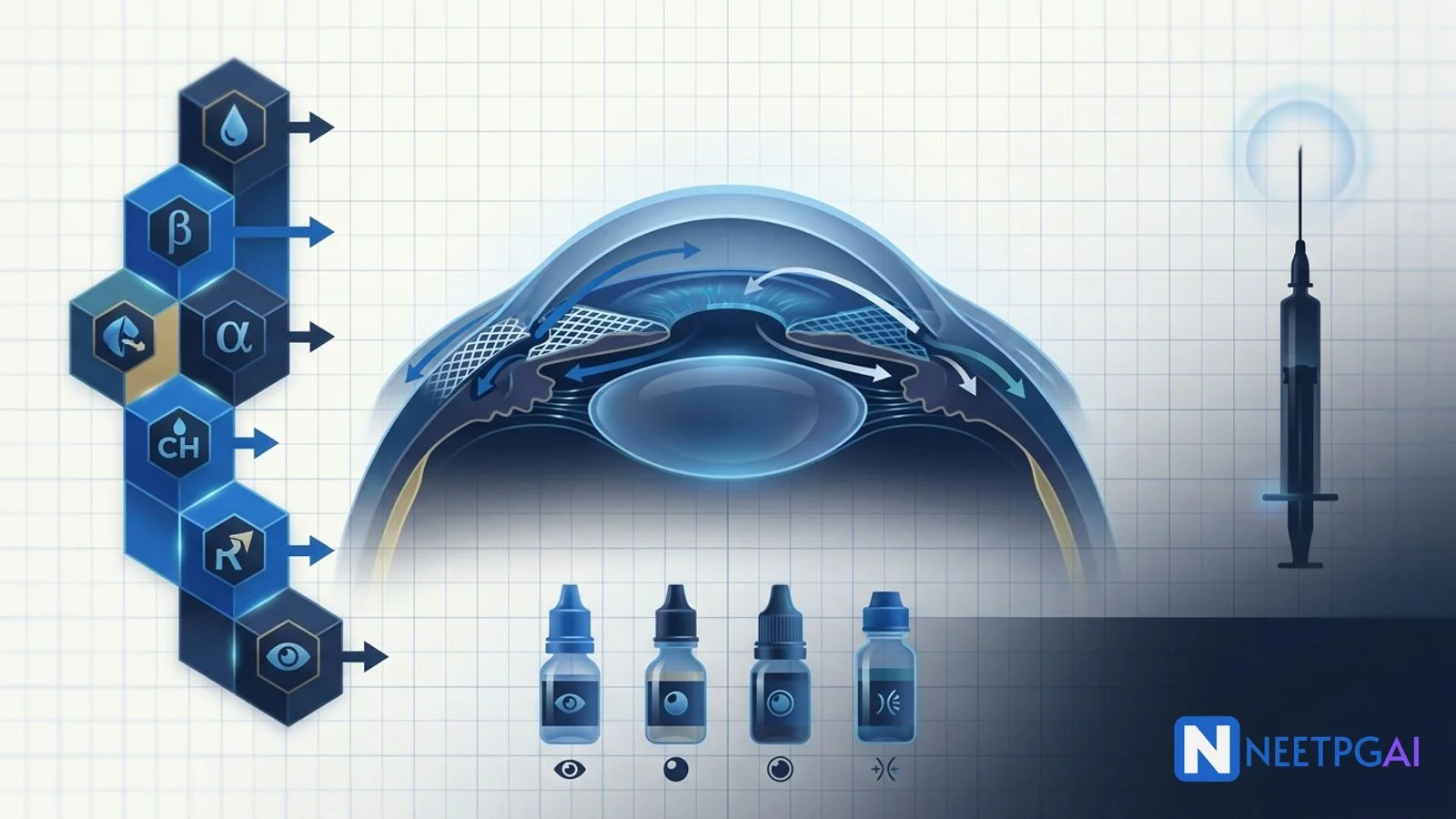
- Prostaglandin analogues — first-line for open-angle glaucoma; increase uveoscleral outflow; once daily; iris pigmentation.
- Beta-blockers — timolol; decrease aqueous production; contraindicated in asthma, bradycardia, heart block.
- Alpha-2 agonists — brimonidine; decrease aqueous + increase outflow; drowsiness in children (avoid under 2).
- CAIs — dorzolamide/brinzolamide topical; acetazolamide oral for acute angle closure; sulfa allergy contraindication.
- Rho kinase inhibitor — netarsudil; increases trabecular outflow; conjunctival hyperaemia.
- Mydriatics/cycloplegics — tropicamide (short), cyclopentolate (medium), atropine (long, amblyopia penalisation); phenylephrine alpha-agonist mydriasis without cycloplegia.
- Anti-VEGF — ranibizumab, aflibercept, brolucizumab, faricimab; bevacizumab off-label; endophthalmitis is the feared complication.
Ophthalmic pharmacology packs a lot into a small topic — glaucoma, mydriasis, anti-VEGF, ocular steroids, allergy drops and dry-eye therapy — and every class carries a signature side effect that examiners love. India's massive undiagnosed glaucoma pool and rising diabetic retinopathy burden mean this topic keeps expanding.
This NEETPGAI deep dive covers all six glaucoma-drug classes, mydriatics and cycloplegics, intravitreal anti-VEGF, ocular steroids and antibiotics, and the India-specific access realities that shape practice. Pair it with the pharmacology core notes to cement mechanism-side-effect pairings.
Glaucoma pharmacology — six classes
Glaucoma treatment lowers intraocular pressure (IOP) by either reducing aqueous production (ciliary body) or increasing outflow (trabecular meshwork or uveoscleral pathway).
1. Prostaglandin analogues (PGAs)
- Drugs — latanoprost, travoprost, bimatoprost, tafluprost (preservative-free option).
- Mechanism — FP-receptor agonism increases uveoscleral outflow (also modestly trabecular). Largest single-drug IOP reduction (25 to 33 percent).
- Dose — once daily at bedtime.
- Side effects — iris hyperpigmentation (often permanent), eyelash lengthening and darkening, periocular pigmentation (may reverse), conjunctival hyperaemia, cystoid macular oedema in pseudophakic eyes (uncommon), reactivation of herpetic keratitis (rare).
- First-line in primary open-angle glaucoma.
2. Beta-blockers
- Drugs — timolol (non-selective), levobunolol, carteolol; betaxolol (beta-1 selective).
- Mechanism — decrease aqueous humour production by ciliary body.
- Dose — usually twice daily; timolol gel-forming solution once daily.
- Side effects — systemic bronchospasm (fatal in asthmatics), bradycardia, heart block, hypotension, worsening heart failure, masks hypoglycaemia, depression, impotence, exercise intolerance.
- Contraindications — asthma, COPD, second- or third-degree AV block, sinus bradycardia, decompensated heart failure. Punctal occlusion reduces systemic absorption.
3. Alpha-2 adrenergic agonists
- Drugs — brimonidine (long-term), apraclonidine (short-term, laser-related IOP spike prevention).
- Mechanism — decrease aqueous production plus increase uveoscleral outflow.
- Dose — 2 to 3 times daily.
- Side effects — ocular allergy (up to 25 percent, common cause for discontinuation), dry mouth, drowsiness, fatigue, hypotension. Contraindicated in children under 2 (CNS depression, apnoea) and used cautiously up to 6.
4. Carbonic anhydrase inhibitors (CAIs)
- Topical — dorzolamide, brinzolamide (twice or three times daily). Less systemic side-effect burden.
- Oral/IV — acetazolamide (250 to 500 mg, up to 4 times daily). Used for acute angle-closure and refractory glaucoma. Also for altitude sickness prophylaxis, idiopathic intracranial hypertension and metabolic-alkalosis correction.
- Mechanism — inhibit CA-II in ciliary body, reducing bicarbonate and hence aqueous secretion.
- Side effects — paraesthesias (fingers, toes, perioral), metallic taste, metabolic acidosis, hypokalaemia, kidney stones (calcium phosphate), aplastic anaemia (rare), Stevens-Johnson syndrome. Sulfa allergy is a contraindication.
5. Rho kinase (ROCK) inhibitors
- Drug — netarsudil (approved 2017 in the US; expanded availability elsewhere).
- Mechanism — increase trabecular meshwork outflow (targets the primary site of resistance in POAG).
- Dose — once daily in the evening.
- Side effects — conjunctival hyperaemia (very common), corneal verticillata, subconjunctival haemorrhage, blepharitis.
6. Cholinergic agonists (miotics)
- Drugs — pilocarpine (direct muscarinic agonist), historically physostigmine (indirect, obsolete for glaucoma).
- Mechanism — contraction of ciliary muscle opens trabecular meshwork; miosis pulls the iris away from angle in acute angle closure.
- Dose — 4 times daily.
- Side effects — brow ache (ciliary spasm), miosis (dim vision), fixed pupil, retinal detachment risk in high myopia, systemic cholinergic effects. Largely superseded by PGAs; still first-line adjunct in acute angle-closure emergency after IOP falls.
Fixed combinations
Dorzolamide-timolol, brimonidine-timolol, latanoprost-timolol, brinzolamide-brimonidine, netarsudil-latanoprost — improve adherence and reduce preservative load.
Acute angle-closure glaucoma emergency algorithm
Immediate priority: lower IOP to preserve vision and clear cornea for iridotomy.
- Topical timolol (unless contraindicated).
- Topical brimonidine.
- Topical dorzolamide or brinzolamide.
- Oral acetazolamide 500 mg (IV if vomiting; caution in sulfa allergy).
- Topical pilocarpine 1 to 2 percent — but only once IOP falls below approximately 50 mmHg, because at very high pressures the iris sphincter is ischaemic and unresponsive; pilocarpine can then paradoxically worsen the angle.
- Topical steroid to control inflammation (e.g. prednisolone acetate).
- IV mannitol 1 to 2 g/kg over 30 minutes if IOP remains extreme or vision threatened; caution in heart failure and renal impairment.
- Position supine (allows lens to fall posteriorly).
- Definitive: laser peripheral iridotomy (YAG) once cornea clears; prophylactic iridotomy of the fellow eye.
Mydriatics and cycloplegics
Mydriasis = pupil dilation. Cycloplegia = paralysis of accommodation (ciliary muscle).
| Drug | Class | Onset/Duration | Use |
|---|
| Tropicamide | Antimuscarinic | 20 min / 4 to 6 h | Fundus exam; short-acting |
| Cyclopentolate | Antimuscarinic | 30 to 60 min / up to 24 h | Cycloplegic refraction in children |
| Homatropine | Antimuscarinic | 30 to 90 min / 1 to 3 days | Uveitis (with steroid) |
| Atropine | Antimuscarinic | 30 to 40 min / 7 to 14 days | Uveitis, amblyopia penalisation, cycloplegic refraction in strabismus |
| Phenylephrine 2.5 or 10 percent | Alpha-1 agonist | 10 to 20 min / 4 to 6 h | Mydriasis WITHOUT cycloplegia; often combined with tropicamide |
Atropine penalisation — 1 percent atropine in the sound eye blurs near vision, forcing the amblyopic eye to work; equivalent to patching for moderate amblyopia in ATS trials with better adherence.
Phenylephrine 10 percent — risk of hypertensive crisis in elderly, cardiovascular disease and children — use 2.5 percent in these groups.
Contraindications for mydriatics — narrow anterior chamber angle (risk of precipitating acute angle closure). Always assess angle depth before dilating in older patients.
Miotics (beyond glaucoma)
Pilocarpine 1.25 percent (Vuity) — approved 2021 for presbyopia; induces pinhole effect via miosis.
Intravitreal anti-VEGF therapy
Drugs — ranibizumab (Fab fragment, approved 2006), aflibercept (fusion protein, VEGF-A plus PlGF), bevacizumab (full antibody, oncology drug used off-label in ophthalmology at much lower cost — a huge factor in Indian access), brolucizumab (single-chain antibody fragment, extended dosing), faricimab (bispecific for VEGF-A plus angiopoietin-2).
Indications — neovascular (wet) age-related macular degeneration (nAMD), diabetic macular oedema (DME), proliferative diabetic retinopathy, macular oedema after retinal vein occlusion, myopic choroidal neovascularisation, retinopathy of prematurity (select cases).
Dose regimens — monthly loading then treat-and-extend or PRN; brolucizumab and faricimab enable 12-week intervals in many patients.
Side effects — endophthalmitis (approximately 0.05 percent per injection — the feared complication; presents days to weeks after injection with pain, hypopyon, vision loss), IOP spike, cataract progression, retinal tear or detachment, small systemic thromboembolic risk (careful in recent stroke or MI), intraocular inflammation (highest for brolucizumab, including retinal vasculitis).
Ocular corticosteroids
Drugs — prednisolone acetate 1 percent (strong, requires shaking), dexamethasone 0.1 percent, loteprednol (softer steroid, lower IOP-rise risk), fluorometholone (lower IOP effect), difluprednate (potent).
Indications — anterior uveitis, post-op inflammation (cataract, refractive surgery), allergic conjunctivitis (severe), scleritis, episcleritis.
Side effects — cataract (posterior subcapsular), steroid-induced glaucoma (in "steroid responders", about 30 percent of population), superinfection (herpes simplex reactivation — never use empirical steroid in dendritic ulcer), delayed wound healing, mydriasis.
Ocular antibiotics
Drops — moxifloxacin, gatifloxacin, tobramycin, chloramphenicol, fusidic acid; combination with steroid (tobramycin-dexamethasone) for select post-op.
Common uses — bacterial conjunctivitis, bacterial keratitis (with fortified antibiotics for severe cases), post-op prophylaxis, corneal abrasion prophylaxis.
Anti-allergy drops
- Dual-action (H1 antagonist plus mast-cell stabiliser) — olopatadine, ketotifen, epinastine, alcaftadine. First-line for allergic conjunctivitis.
- Mast-cell stabilisers — cromoglycate, nedocromil, lodoxamide.
- H1 antihistamines — emedastine.
- Steroid drops — for severe or vernal keratoconjunctivitis (short courses, monitor IOP and cataract).
- Ciclosporin 0.05 or 0.1 percent — for severe vernal keratoconjunctivitis and dry eye.
Dry eye therapy
Artificial tears (carboxymethylcellulose, hyaluronate, polyethylene glycol) — mainstay. Cyclosporine 0.05 percent (Restasis) reduces T-cell inflammation. Lifitegrast (LFA-1 antagonist) alternative anti-inflammatory. Autologous serum drops in severe cases. Punctal plugs for aqueous deficient dry eye. Lipid layer measures (warm compresses, lid hygiene, meibomian gland expression) for evaporative dry eye.
NEET PG MCQ traps
- PGA side effect — iris pigmentation (permanent), eyelash lengthening.
- Timolol contraindication — asthma, bradycardia, heart block, heart failure.
- Betaxolol — beta-1 selective; slightly safer in mild reactive airway disease.
- Brimonidine in under-2s — CNS depression, apnoea; contraindicated.
- Acetazolamide — paraesthesias, kidney stones, metabolic acidosis, hypokalaemia; sulfa allergy.
- Pilocarpine in acute angle closure — only after IOP falls below approximately 50 mmHg.
- IV mannitol dose — 1 to 2 g/kg for acute angle closure.
- Definitive angle closure treatment — laser peripheral iridotomy.
- Atropine cycloplegia duration — 7 to 14 days.
- Amblyopia penalisation — atropine 1 percent to sound eye; equivalent to patching (ATS).
- Phenylephrine 10 percent — hypertensive risk in elderly and children.
- Endophthalmitis after injection — approximately 0.05 percent per injection.
- Bevacizumab off-label ophthalmic — used at fraction of cost of ranibizumab; key access in India.
- Steroid drops in dendritic ulcer — contraindicated; risk of geographic ulcer.
- Steroid-induced glaucoma — "steroid responders"; monitor IOP.
- Loteprednol — softer steroid, lower IOP-rise risk.
- Cyclosporine drops — chronic dry eye, vernal keratoconjunctivitis.
- Olopatadine — dual-action allergy drop; first-line.
- Timolol in glaucoma pregnancy — category C; risk-benefit; PGA and CAI drops preferred; punctal occlusion.
- Rifampicin, ethambutol, hydroxychloroquine, chloroquine ocular toxicity — retinal (HCQ bulls-eye maculopathy), optic neuritis (ethambutol dose- and duration-dependent).
India-specific context
- Glaucoma burden — approximately 12 million affected; over 90 percent undiagnosed at first presentation; primary angle-closure common in South Indian populations.
- Diabetic retinopathy — India has world's largest diabetes population; DR screening expanding via LVPEI, Sankara, Aravind and Rashtriya Bal Swasthya Karyakram.
- Anti-VEGF affordability — bevacizumab off-label is the workhorse (approximately one-tenth the cost of ranibizumab or aflibercept); PMJAY coverage of intravitreal therapy is patchy.
- National Programme for Control of Blindness (NPCBVI) — glaucoma clinics expanding; cataract still dominates operative volumes.
- Traditional eye-drop use — kohl and herbal preparations remain a public-health concern in paediatric ophthalmology (lead toxicity, chemical injury).
Frequently asked questions
Which drug class is first-line for open-angle glaucoma and why?
Prostaglandin analogues (latanoprost, travoprost, bimatoprost, tafluprost) are first-line for primary open-angle glaucoma. They lower intraocular pressure by 25 to 33 percent — the largest single-drug reduction — via increased uveoscleral outflow. Once-daily dosing improves adherence. Side effects: iris hyperpigmentation (often permanent), eyelash lengthening and thickening, periocular pigmentation, and rare cystoid macular oedema in pseudophakic eyes.
What is the acute angle-closure glaucoma medical treatment algorithm?
Acute angle-closure glaucoma is a sight-threatening emergency. Immediate combination: topical pilocarpine 1 to 2 percent (once IOP falls below approximately 50 mmHg so the iris sphincter can respond), topical timolol, topical brimonidine and topical dorzolamide (or brinzolamide), plus oral or IV acetazolamide 500 mg. Add IV mannitol 1 to 2 g/kg if IOP remains extreme or vision is threatened. Definitive treatment is laser peripheral iridotomy (usually YAG) once cornea clears and IOP settles.
Why is atropine used for amblyopia penalisation?
Atropine 1 percent to the better-seeing eye blurs its near vision by cycloplegia (7 to 14 days full recovery per dose), forcing the amblyopic (weaker) eye to work — the pharmacological equivalent of patching. Atropine penalisation is comparable in efficacy to patching for moderate amblyopia (ATS studies), has better adherence and avoids skin problems from patches. Best avoided in dark irides (unpredictable response) and in children under 4 (systemic absorption risk from lacrimal drainage). Punctal occlusion reduces systemic absorption.
What are the main intravitreal anti-VEGF agents and their indications?
Ranibizumab, aflibercept, brolucizumab and faricimab are approved intravitreal anti-VEGFs; bevacizumab is used off-label at much lower cost (a key access point in India). Indications: wet age-related macular degeneration, diabetic macular oedema, retinal vein occlusion macular oedema, proliferative diabetic retinopathy, myopic choroidal neovascularisation, and ROP in selected cases. Serious risks: endophthalmitis (approximately 0.05 percent per injection), IOP spike, retinal detachment, small systemic thromboembolic risk. Faricimab targets both VEGF-A and angiopoietin-2 for extended dosing.
Which glaucoma drugs are contraindicated in asthma and why?
Topical non-selective beta-blockers — timolol, levobunolol, carteolol — are contraindicated in asthma, COPD and severe bronchospastic disease because systemic absorption via nasolacrimal drainage causes beta-2 blockade with potentially fatal bronchoconstriction. They are also unsafe in bradycardia, heart block above first degree, decompensated heart failure and mask hypoglycaemia in insulin-dependent diabetes. Betaxolol is beta-1 selective and safer in mild reactive airway disease but not truly safe. Punctal occlusion for 2 minutes after instillation reduces systemic absorption.
This content is for educational purposes for NEET PG exam preparation. It is not a substitute for professional medical advice, diagnosis, or treatment. Clinical information has been reviewed by qualified medical professionals.
Written by: NEETPGAI Editorial Team
Reviewed by: Pending SME Review
Last reviewed: September 2026