Quick Answer
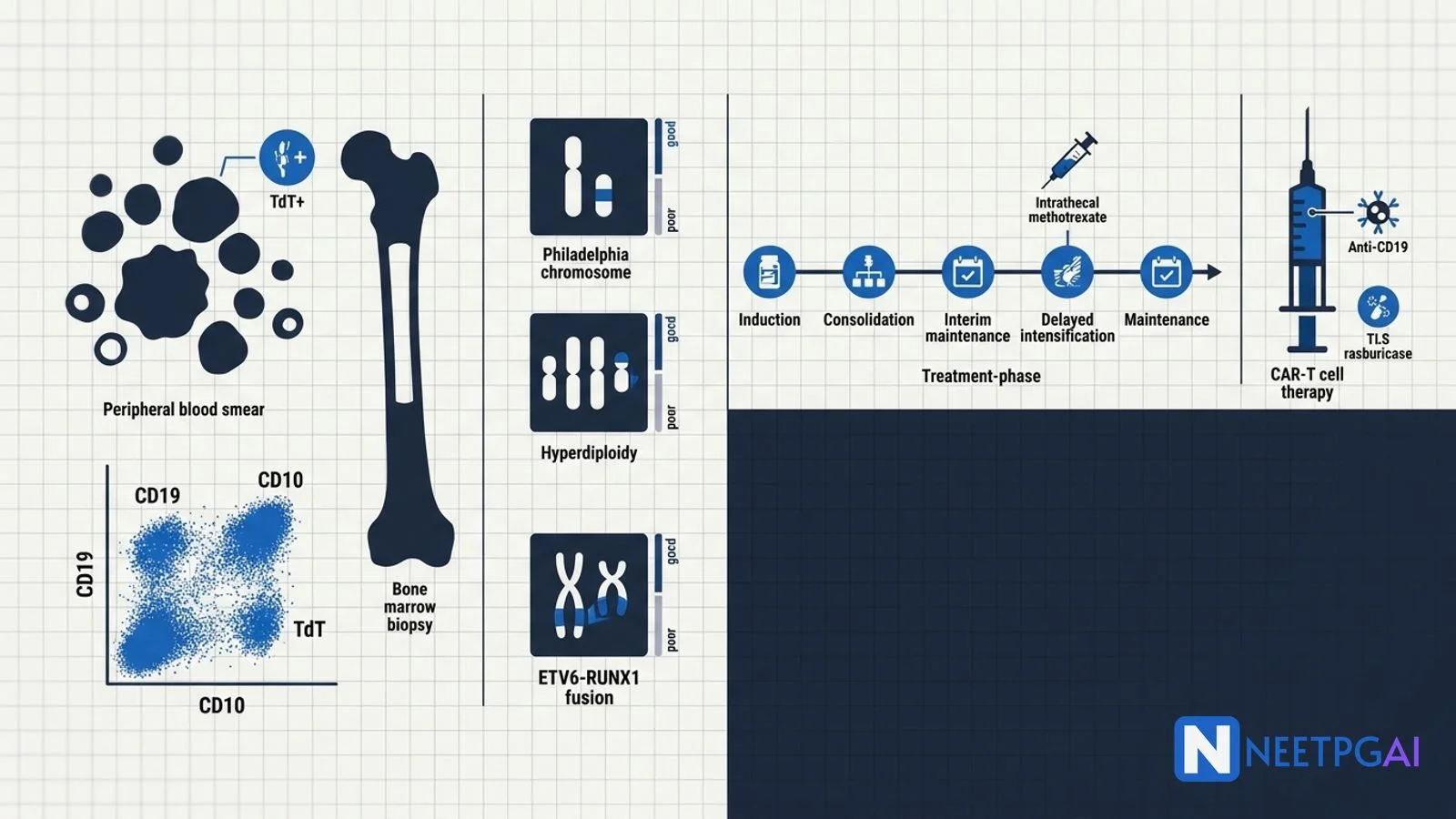
Pediatric ALL is a 2 to 3 question topic per NEET PG paper across pediatrics, medicine (haematology), and community medicine (childhood cancer registry). Lock these:
- Commonest childhood cancer — ALL ~25 percent of paediatric cancers; peak 2-5 years; boys slightly greater than girls.
- Down syndrome — 10 to 20 fold ALL risk (also increased AML).
- Presentation — bone marrow failure (pallor, bruising, infection) + hepatosplenomegaly + bone pain (refuse to walk).
- Diagnosis — bone marrow aspirate + biopsy over 25 percent lymphoblasts + immunophenotyping.
- B-ALL 80-85 percent (CD19/CD22/CD10/TdT); T-ALL 15 percent (CD3/CD7, mediastinal mass).
- Favourable cytogenetics — hyperdiploidy over 50 chromosomes, ETV6-RUNX1 t(12;21).
- Poor cytogenetics — hypodiploidy, BCR-ABL1 Philadelphia t(9;22), MLL/KMT2A, iAMP21.
- NCI risk — standard = age 1-9 + WBC under 50,000; high = age under 1 or over 10 or WBC over 50,000.
- MRD under 0.01 percent at day 29 — strongest predictor of long-term survival.
- Treatment phases — induction 4-5 weeks, consolidation, interim maintenance, delayed intensification, maintenance 2-3 years.
- CNS prophylaxis — intrathecal methotrexate + high-dose systemic MTX; cranial radiation only for CNS3 or high-risk T-ALL.
- Ph+ ALL — add TKI (imatinib, dasatinib) throughout.
- Relapsed/refractory — blinatumomab (CD3-CD19 BiTE), inotuzumab (anti-CD22 ADC), tisagenlecleucel CAR-T (CD19).
- Tumor lysis prophylaxis — hydration + allopurinol (rasburicase for high risk).
- India context — 5-year OS 65-75 percent in cooperative-trial centres; PMJAY, InPOG, Cankids.
Acute lymphoblastic leukemia is the paradigm childhood cancer — the first solid tumour to be reliably cured, the model for cooperative-group protocol-driven care, and the leading indication for modern paediatric cell therapy (CAR-T). NEET PG tests diagnosis, immunophenotype, cytogenetics risk, treatment phases, and India programmatic context.
This deep dive walks through epidemiology → presentation → work-up and immunophenotyping → cytogenetics and risk stratification → phased treatment → relapsed and refractory therapy → supportive care and late effects → Indian access landscape.
Epidemiology and risk factors
- Approximately 25 percent of childhood cancers and 75 percent of childhood leukemias — the single most common paediatric malignancy
- Peak age 2 to 5 years; boys slightly greater than girls; B-cell ALL 80-85 percent; T-cell ALL 10-15 percent
- Constitutional risk factors:
- Down syndrome — 10 to 20 fold risk (both ALL and AML)
- Fanconi anaemia, Bloom syndrome, ataxia-telangiectasia
- Neurofibromatosis type 1, Li-Fraumeni syndrome (TP53)
- Twin/sibling of affected child — 2-4 fold risk
- Environmental risk factors:
- Ionising radiation (in utero X-ray, previous radiotherapy)
- Benzene, previous chemotherapy (treatment-related leukemia)
- Delayed infection hypothesis (Greaves)
- Not proven — electromagnetic fields, mobile phones, vaccinations
Clinical presentation
- Bone marrow failure — pallor and fatigue (anaemia), bruising and petechiae (thrombocytopenia), fever and infection (neutropenia)
- Extramedullary infiltration — hepatosplenomegaly (60-70 percent), lymphadenopathy, bone pain (may refuse to walk in a young child), testicular painless swelling (boys, especially at relapse)
- CNS involvement — headache, vomiting, cranial nerve palsies (CN VI, VII most common), meningismus
- Mediastinal mass — classic for T-cell ALL — respiratory distress, superior vena cava syndrome, tracheal compression
- Fever of unknown origin in the child with persistent CBC abnormalities
Any child with persistent pallor, bruising, bone pain, or hepatosplenomegaly greater than 2 weeks needs urgent CBC and peripheral smear.
Diagnostic work-up
1. Complete blood count and peripheral smear
- WBC variable — high, normal, or low; classic pattern is leukocytosis with lymphoblasts on smear
- Anaemia, thrombocytopenia usually present
- Lymphoblasts are large cells with high N:C ratio, fine chromatin, prominent nucleoli, and scant basophilic cytoplasm
- TdT (terminal deoxynucleotidyl transferase) positive on immunohistochemistry — hallmark of lymphoblasts
2. Bone marrow aspiration and biopsy
- Diagnostic threshold — over 25 percent lymphoblasts in the marrow
- FAB morphology — L1 (small, uniform), L2 (larger, more variable), L3 (Burkitt-like — mature B-ALL, treated as lymphoma)
- Cellularity, dysplasia, presence of other lineages
3. Immunophenotyping (flow cytometry)
| Lineage | Markers | Notes |
|---|
| Pro-B (early precursor B) | CD19, CD22, CD79a, TdT, CD10 negative | Poor prognosis; often infant ALL |
| Common ALL (cALL) | CD10 positive + above | Commonest B-ALL; best prognosis |
| Pre-B | Cytoplasmic mu heavy chain + above | Good prognosis |
| Mature B (Burkitt) | Surface immunoglobulin + | Treated as lymphoma (short intensive) |
| T-ALL | CD3, CD7, CD2, CD5, CD4/CD8 variable | Older boys, mediastinal mass, high WBC |
4. Cytogenetics and molecular
| Category | Abnormality | Prognosis |
|---|
| Favourable | Hyperdiploidy (over 50 chromosomes, esp. trisomies 4, 10, 17) | Excellent |
| Favourable | ETV6-RUNX1 t(12;21) | Excellent |
| Intermediate | Normal karyotype | Intermediate |
| Intermediate | TCF3-PBX1 t(1;19) | Intermediate to good |
| Poor | Hypodiploidy (under 44 chromosomes) | Poor |
| Poor | BCR-ABL1 t(9;22) — Philadelphia+ | Poor without TKI; improved with TKI |
| Poor | MLL/KMT2A rearrangement | Poor (especially infant ALL) |
| Poor | iAMP21 (intrachromosomal amplification chr 21) | Poor |
| Ph-like | IKZF1 deletion + kinase-activating alterations | Poor; targeted TKI in some |
5. CSF (lumbar puncture with cytospin)
- CNS1 — no blasts in CSF, WBC under 5
- CNS2 — under 5 WBC/microlitre with blasts present
- CNS3 — over 5 WBC/microlitre with blasts (overt CNS leukemia; needs cranial radiation)
- Traumatic tap with blasts is separately reported
6. Additional
- Chest X-ray — mediastinal mass in T-ALL
- Testicular examination — testicular involvement
- Electrolytes, uric acid, LDH, phosphate, calcium — tumour lysis baseline
- Coagulation profile (DIC screen), hepatitis and HIV serology
- Echocardiogram — baseline before anthracycline
Risk stratification (NCI + biology + response)
NCI criteria (initial)
- Standard risk — age 1 to under 10 years AND WBC under 50,000
- High risk — age under 1 (infant ALL, usually MLL-rearranged, very poor); age over 10 years; WBC 50,000 or more; CNS3 or testicular disease
Biologic modifiers
- Favourable genetics (hyperdiploidy, ETV6-RUNX1) — reduce risk
- Poor genetics (hypodiploidy, MLL, Ph+, iAMP21) — increase risk
Treatment response (dominant modern factor)
- MRD (minimal residual disease) by flow cytometry or PCR at day 29 (end of induction) and end of consolidation
- MRD under 0.01 percent — favourable
- MRD 0.01 percent or higher — high risk; augment therapy
Treatment phases
Phase 1 — Induction (4-5 weeks)
- Backbone — vincristine + corticosteroid (dexamethasone in B-ALL; prednisolone in T-ALL) + asparaginase (native or pegylated) + intrathecal methotrexate at day 1, 8, 15
- Anthracycline — daunorubicin or doxorubicin added for high-risk patients
- Goal — morphologic complete remission (under 5 percent blasts) by day 29 AND MRD under 0.01 percent
- Ph+ ALL — add TKI (imatinib or dasatinib) from day 15
Phase 2 — Consolidation (4-8 weeks)
- Cyclophosphamide + cytarabine + 6-mercaptopurine
- Intensify remission, target sanctuary sites
Phase 3 — Interim maintenance
- High-dose methotrexate + 6-MP (or Capizzi-style escalating IV methotrexate + asparaginase)
Phase 4 — Delayed intensification
- Reinduction (vincristine + dexamethasone + asparaginase) + reconsolidation (cyclophosphamide + cytarabine + 6-thioguanine)
Phase 5 — Maintenance (2-3 years)
- Daily oral 6-mercaptopurine
- Weekly oral methotrexate
- Monthly IV vincristine + 5-day dexamethasone pulse
- Periodic intrathecal methotrexate
- Continued for total treatment duration 2 years (girls) to 3 years (boys) from diagnosis
CNS-directed therapy
- Intrathecal methotrexate at almost every visit (single-agent or triple — MTX + hydrocortisone + cytarabine)
- High-dose systemic methotrexate — crosses the blood-brain barrier
- Cranial radiation (12-18 Gy) — reserved for CNS3 at diagnosis, high-risk T-ALL with high WBC, or CNS relapse; avoided in most patients due to long-term neurocognitive, endocrine, growth, and second-malignancy effects
Relapsed and refractory ALL
Timing of relapse
- Very early — during therapy (worst prognosis)
- Early — under 36 months from diagnosis
- Late — over 36 months from diagnosis
- Site — bone marrow (commonest), CNS, testicular, combined
Treatment options
- Re-induction chemotherapy — clofarabine-based, high-dose cytarabine-based regimens
- Blinatumomab — bispecific T-cell engager (BiTE) with anti-CD19 and anti-CD3 arms; approved for relapsed/refractory B-ALL and increasingly for MRD-positive first-line; toxicities — cytokine release syndrome, neurotoxicity
- Inotuzumab ozogamicin — anti-CD22 antibody-drug conjugate (linked to calicheamicin); approved for relapsed/refractory CD22-positive B-ALL; toxicity — veno-occlusive disease of the liver, especially peri-HCT
- Tisagenlecleucel (CAR-T) — autologous anti-CD19 chimeric antigen receptor T-cell therapy; approved 2017 for children and young adults with relapsed/refractory B-ALL after 2 lines of therapy or post-HCT relapse; 80-90 percent CR rate in this heavily pretreated group; toxicities — cytokine release syndrome (managed with tocilizumab + steroids), ICANS
- Allogeneic HCT — for induction failure, high MRD, MLL-rearranged infant ALL, second CR after early relapse
Supportive care
Tumour lysis syndrome (TLS) prevention and management
- High-risk — high WBC, high LDH, T-ALL with mediastinal mass, Burkitt-like B-ALL
- Prophylaxis — aggressive hydration (3 L/m squared per day), allopurinol (xanthine oxidase inhibitor) for standard risk
- High-risk — rasburicase (recombinant urate oxidase; converts uric acid to allantoin — soluble; avoid in G6PD deficiency — methemoglobinemia)
- Monitoring — potassium, phosphate, calcium, uric acid, creatinine every 6-12 hours during induction
- Management — treat hyperkalaemia (calcium gluconate + insulin-glucose), hyperphosphatemia (binders), hyperuricemia (rasburicase), hypocalcemia (calcium replacement only if symptomatic — precipitation of calcium phosphate); dialysis if refractory
Neutropenic fever
- Fever plus ANC under 500 — start empiric broad-spectrum antibiotics (piperacillin-tazobactam or cefepime) within 60 minutes
- Add vancomycin for suspected line infection or Gram-positive infection
- Antifungal (voriconazole, echinocandin) if persistent fever over 5 days
- Blood cultures, CXR, urine culture, LP if headache
Infection prophylaxis
- PCP prophylaxis — trimethoprim-sulfamethoxazole 3 days per week throughout therapy and 6 months after
- Antifungal — fluconazole or posaconazole in high-risk phases
- Antiviral — acyclovir if HSV/VZV history
- Vaccination — no live vaccines during and 6 months after chemotherapy; revaccinate on completion
Blood product support
- Irradiated leukoreduced RBCs and platelets to prevent TA-GVHD (transfusion-associated graft-vs-host disease)
- CMV-negative products for CMV-negative recipient
- Threshold — Hb under 7 for transfusion; platelets under 10 (no bleeding) or under 20 (fever/mucositis)
Growth factors
- G-CSF (filgrastim) for prolonged neutropenia; not routine in ALL induction
Managing chemotherapy toxicity
- Mucositis — oral hygiene, cryotherapy for MTX, palifermin
- Nausea/vomiting — 5-HT3 antagonists + dexamethasone + aprepitant
- Hepatotoxicity — from methotrexate, 6-MP, asparaginase
- Vincristine neuropathy — foot drop, ileus, jaw pain; dose modification
- Asparaginase — pancreatitis, thrombosis (cerebral sinus venous thrombosis classic), hyperammonaemia, hyperglycaemia
Late effects of treatment
- Second malignancy — treatment-related AML/MDS (topoisomerase II inhibitors like etoposide); solid tumours (breast, thyroid — from radiation)
- Cardiotoxicity — anthracycline dose-related (cumulative dose limit) — chronic heart failure years later
- Endocrine — growth hormone deficiency, hypothyroidism, gonadal failure (higher with cyclophosphamide and radiation)
- Neurocognitive — from CNS-directed therapy; worse with cranial radiation
- Growth impairment — from cranial radiation, steroids
- Osteonecrosis — from steroids; hip and knee; adolescents at highest risk
- Cataracts — from steroids and radiation
- Infertility — from alkylating agents (cyclophosphamide); consider fertility preservation in post-pubertal adolescents
India-specific context
- Approximately 50,000 new childhood cancers per year in India (under 15 years); ALL the single largest slice
- 5-year overall survival in cooperative-trial centres — 65-75 percent (up from 40-50 percent in the 2000s; approaching 90 percent in high-income countries)
- Treatment abandonment — 10-20 percent in some series; driven by cost, distance, and cultural factors
- Programmatic support:
- Ayushman Bharat PM-JAY — up to Rs 5 lakh per family per year for paediatric oncology; several state top-ups
- National Cancer Grid + InPOG (Indian Paediatric Oncology Group) — cooperative protocols, standardised MRD-guided ALL treatment, data sharing across 250+ centres
- State cancer control programmes — Karnataka, Tamil Nadu, Kerala have subsidised paediatric oncology
- RBSK — screens 0-18 year-olds; includes cancer suspicion referral
- Non-governmental organisations — Cankids Kidscan, St Jude India Childcare Centres, Access Life Assistance Foundation — free lodging, food, transport, emotional support near paediatric oncology hospitals; dramatically reduced abandonment
- Prime Minister's National Relief Fund — catastrophic expenditure not met by insurance
- Indigenous CAR-T — IIT-Bombay + Tata Memorial NexCAR19 (approved 2023); India's first indigenous CD19 CAR-T; drastically lower cost than imported tisagenlecleucel
NEET PG MCQ traps
- Commonest childhood cancer — ALL (~25 percent of paediatric cancers).
- Peak age — 2 to 5 years; boys slightly greater than girls.
- Down syndrome — 10-20 fold ALL risk (also increased AML).
- Bone pain — a young child refusing to walk with fever, pallor — think ALL.
- Bone marrow diagnostic threshold — over 25 percent lymphoblasts.
- TdT — positive in lymphoblasts (both B and T precursor), negative in AML.
- Common ALL (cALL) — CD10 positive; commonest B-ALL; best prognosis.
- T-ALL clues — older boy, mediastinal mass, high WBC, high CNS involvement risk.
- Favourable cytogenetics — hyperdiploidy over 50 chromosomes; ETV6-RUNX1 t(12;21).
- Poor cytogenetics — hypodiploidy, BCR-ABL1 t(9;22), MLL/KMT2A, iAMP21.
- Infant ALL (under 1 year) — usually MLL-rearranged; very poor prognosis.
- NCI standard risk — age 1-9 + WBC under 50,000.
- MRD under 0.01 percent at day 29 — strongest predictor of survival.
- CNS3 — over 5 WBC/microlitre with blasts on cytospin (overt CNS disease).
- Ph+ ALL — add TKI (imatinib, dasatinib) from day 15 of induction.
- Vincristine toxicity — peripheral neuropathy, foot drop, jaw pain, ileus.
- Asparaginase toxicity — pancreatitis, thrombosis (CSVT classic), hyperammonaemia, hyperglycaemia.
- Cranial radiation — reserved for CNS3 or high-risk T-ALL (neurocognitive + second malignancy risk).
- PCP prophylaxis — TMP-SMX throughout therapy and 6 months after.
- Rasburicase — recombinant urate oxidase for TLS; contraindicated in G6PD deficiency.
- Blinatumomab — CD3-CD19 bispecific; CRS + neurotoxicity.
- Inotuzumab — anti-CD22 ADC (calicheamicin); VOD of liver.
- Tisagenlecleucel — CD19 CAR-T; 80-90 percent CR in R/R B-ALL; CRS + ICANS.
- HCT indications — induction failure, high MRD, MLL infant ALL, second CR after early relapse.
- Anthracycline — dose-related cumulative cardiotoxicity.
- Testicular relapse — sanctuary site; painless swelling; investigate carefully.
- Total treatment duration — 2 years (girls) to 3 years (boys) — historical difference in maintenance.
- Down syndrome ALL — better response but more toxicity (methotrexate especially); avoid high-dose MTX.
- NexCAR19 — India's indigenous CD19 CAR-T (Tata Memorial + IIT-Bombay, 2023).
Recent updates and Indian context
- MRD-guided therapy — day 29 and end-of-consolidation MRD now standard for augmenting or de-escalating therapy in cooperative-group protocols
- Blinatumomab in first-line — increasing use for MRD-positive high-risk B-ALL to eradicate MRD before consolidation (COG AALL1731 and similar)
- CAR-T uptake in India — tisagenlecleucel imported at select centres; NexCAR19 (Tata Memorial + IIT-Bombay indigenous CD19 CAR-T) approved by CDSCO 2023 at fraction of imported cost
- Ph-like ALL — recognised distinct entity; some subgroups respond to TKIs (ABL-class, JAK-class alterations)
- Reduced cranial radiation — modern protocols eliminate cranial radiation for almost all patients (only CNS3, some T-ALL) to reduce late effects
- InPOG cooperative trials — running MRD-guided protocols across Indian centres; standardising care and driving outcomes upward
- NexCAR19 cost — dramatically lower than imported CAR-T; expanding access
- Fertility preservation — sperm banking and ovarian tissue cryopreservation increasingly offered pre-therapy in adolescents
- Cost of chemotherapy — largely generic (asparaginase, TKIs generic in India); the barriers are supportive care, transplant, and cellular therapy
Frequently asked questions
Why is pediatric ALL the commonest childhood cancer and what are the risk factors?
Acute lymphoblastic leukemia accounts for approximately 25 percent of all childhood cancers and about 75 percent of childhood leukemias, making it the single most common paediatric malignancy worldwide including India. Peak incidence is between 2 and 5 years of age, boys are slightly more commonly affected than girls, and B-cell precursor ALL constitutes 80-85 percent of paediatric cases with T-cell ALL constituting 15 percent. Genetic and constitutional risk factors — Down syndrome carries a 10 to 20 fold increased ALL risk, other syndromic risks include Fanconi anaemia, Bloom syndrome, ataxia-telangiectasia, neurofibromatosis type 1, and Li-Fraumeni syndrome; sibling of an affected child has 2-4 fold risk. Environmental risk factors — ionising radiation exposure (in utero X-ray, radiotherapy), chemical exposure (benzene, chemotherapy for a previous malignancy — treatment-related ALL), and possible associations with prenatal infection timing (delayed infection hypothesis). Despite popular concern, no strong link has been established with electromagnetic fields, mobile phones, or vaccinations. Because ALL peaks in a very young child with a nonspecific illness, delayed diagnosis is common — a child with persistent pallor, bruising, bone pain, fever, or hepatosplenomegaly for more than 2 weeks warrants urgent CBC and peripheral smear referral. India specifically bears a large ALL burden proportional to population size but with poorer outcomes than developed countries because of delayed presentation, treatment abandonment, and limited access to modern supportive care and immunotherapy.
How do you interpret immunophenotyping and cytogenetics for ALL risk stratification?
Immunophenotyping by flow cytometry defines ALL lineage and prognosis and is now standard of care in every diagnostic bone marrow aspirate. B-lineage ALL (80-85 percent) expresses CD19, CD22, and cytoplasmic CD79a — subdivided into pro-B (CD10 negative), common ALL (CD10 positive — best prognosis, called common because it is the commonest subtype), pre-B (cytoplasmic mu heavy chain positive), and mature B (surface immunoglobulin positive — treated as Burkitt lymphoma with short intensive lymphoma protocols rather than long ALL protocols). T-lineage ALL (10-15 percent) expresses CD3, CD7, CD2, CD5, CD4/CD8 in various combinations — often presents in older boys with a large mediastinal mass, high white cell count, and CNS involvement; TdT is positive in both B and T precursor ALL, distinguishing lymphoblasts from mature lymphoma. Cytogenetics and molecular genetics stratify risk and guide therapy — favourable prognosis markers include hyperdiploidy (over 50 chromosomes, especially trisomies of 4, 10, and 17) and the ETV6-RUNX1 fusion from t(12;21), both of which do very well; intermediate include normal karyotype and the TCF3-PBX1 fusion from t(1;19); poor prognosis includes hypodiploidy (under 44 chromosomes), the Philadelphia chromosome BCR-ABL1 fusion from t(9;22) which requires a tyrosine kinase inhibitor added to chemotherapy, MLL/KMT2A rearrangements especially in infant ALL, and intrachromosomal amplification of chromosome 21 (iAMP21). Age and initial white cell count are the other National Cancer Institute risk factors — age between 1 and 9 years plus WBC under 50,000 defines standard risk; age under 1 year (infant ALL, usually MLL rearranged, very poor) or age 10 and above or WBC over 50,000 defines high risk. Minimal residual disease (MRD) measurement at end of induction (day 29) and end of consolidation is now the dominant modifiable prognostic factor — MRD under 0.01 percent at day 29 is the strongest predictor of long-term survival.
What are the phases of ALL treatment and why does maintenance last 2-3 years?
Pediatric ALL treatment is a prolonged multi-phase regimen lasting a total of 2-3 years, structured to hit residual leukaemia at each biological vulnerability and to prevent CNS relapse. Phase 1 is induction (4-5 weeks) — vincristine, dexamethasone (or prednisolone in T-ALL), asparaginase (native or pegylated), and intrathecal methotrexate; an anthracycline (daunorubicin or doxorubicin) is added for high-risk patients; the goal is to achieve morphological complete remission (under 5 percent blasts in the marrow) and ideally MRD under 0.01 percent by day 29. Phase 2 is consolidation (4-8 weeks) — cyclophosphamide, cytarabine, and 6-mercaptopurine intensify remission and target sanctuary sites. Phase 3 is interim maintenance — repeated cycles of intermediate or high-dose methotrexate with 6-MP; Capizzi-style escalating IV methotrexate is an alternative. Phase 4 is delayed intensification (reinduction and reconsolidation) — repeats the intensive drugs to eradicate any recovering blasts. Phase 5 is maintenance for 2-3 years — daily oral 6-mercaptopurine, weekly oral methotrexate, monthly IV vincristine, and 5-day dexamethasone pulses; intrathecal chemotherapy continues periodically; the rationale for such prolonged maintenance is that ALL blasts are slowly proliferating and cell-cycle dependent, so continuous low-intensity antimetabolite exposure over years is required to eradicate the last residual clones; historical trials that shortened maintenance to less than 2 years showed significantly higher relapse rates. CNS-directed therapy runs in parallel throughout — intrathecal methotrexate at almost every visit, high-dose systemic methotrexate that crosses the blood-brain barrier, and cranial radiation reserved for CNS3 disease at diagnosis or T-ALL with high WBC because of long-term neurocognitive, endocrine, and second-malignancy effects.
What is the role of tyrosine kinase inhibitors, blinatumomab, inotuzumab and CAR-T in modern ALL therapy?
Targeted and immune therapies have transformed the landscape of high-risk and relapsed pediatric ALL over the past decade. Tyrosine kinase inhibitors (imatinib, dasatinib, ponatinib) are added to standard chemotherapy for Philadelphia chromosome positive ALL (BCR-ABL1 fusion from t(9;22)) — trial data from EsPhALL and COG show TKI-plus-chemotherapy roughly doubles event-free survival versus historical chemotherapy alone, and TKI is now given from day 15 of induction and continued throughout maintenance. Blinatumomab is a bispecific T-cell engager (BiTE) that has an anti-CD19 arm binding to B-lymphoblasts and an anti-CD3 arm engaging T cells to lyse them — used for relapsed and refractory B-ALL, and increasingly in first-line consolidation for MRD-positive high-risk patients; toxicities include cytokine release syndrome and neurotoxicity. Inotuzumab ozogamicin is an antibody-drug conjugate — a monoclonal anti-CD22 antibody linked to calicheamicin, a potent DNA-damaging agent — used for relapsed/refractory CD22-positive B-ALL; the notable toxicity is veno-occlusive disease of the liver, especially before or after HCT. Tisagenlecleucel is autologous chimeric antigen receptor T-cell therapy (CAR-T) targeting CD19 — patient's T cells are collected, genetically engineered to express an anti-CD19 CAR, expanded, and reinfused; it was approved by FDA in 2017 for children and young adults with relapsed/refractory B-ALL after 2 or more lines of therapy or after HCT relapse, with complete remission rates of 80-90 percent in this heavily pretreated population; major toxicities are cytokine release syndrome (managed with tocilizumab and steroids) and immune effector cell associated neurotoxicity syndrome (ICANS). Haematopoietic cell transplantation (allogeneic HCT) is used for very high risk induction failure, persistent MRD, MLL-rearranged infant ALL, and second complete remission after early relapse. In India, TKIs are widely available generically; blinatumomab and inotuzumab are increasingly used in tertiary paediatric oncology centres; tisagenlecleucel is available at select academic centres with cost being the major barrier (currently over Rs 4 crore, though CDSCO approval and indigenous CAR-T programmes at IIT-Bombay and Tata Memorial are working to bring costs down).
What Indian government programmes and paediatric oncology networks support ALL treatment access?
India carries a large paediatric cancer burden (approximately 50,000 new cases per year in children under 15, of which ALL is the single largest slice) but historically has poor outcomes compared with high-income countries because of late presentation, treatment abandonment, and inequitable access. Programmatic responses include (1) Ayushman Bharat PM-JAY — provides up to Rs 5 lakh per family per year for hospitalisation including paediatric oncology packages (chemotherapy, radiotherapy, supportive care) in empanelled hospitals; several state schemes top this up. (2) National Cancer Grid — a consortium of over 250 cancer centres coordinated by Tata Memorial Centre that standardises paediatric oncology protocols across India through the InPOG (Indian Paediatric Oncology Group) initiative; InPOG runs cooperative trials, standardises MRD-guided ALL treatment, and shares data. (3) State cancer control programmes — Karnataka, Tamil Nadu, and Kerala have subsidised paediatric oncology at their government cancer institutes. (4) Rashtriya Bal Swasthya Karyakram (RBSK) — screens 0-18 year-olds for the 4Ds (defects, deficiencies, diseases, developmental delays) and includes suspicion of cancer as a referral trigger to district early intervention centres. (5) Cankids Kidscan, St Jude India Childcare Centres, Access Life Assistance Foundation — non-governmental organisations providing free lodging, food, transport, and emotional support to families of children with cancer; these hostels are located near major paediatric oncology hospitals and have dramatically reduced treatment abandonment. (6) Prime Minister's National Relief Fund — covers catastrophic health expenditure not met by insurance. India-specific challenges — treatment abandonment (still 10-20 percent in some series, driven by cost, distance, and cultural factors), late presentation reducing cure rates, disparities between urban tertiary and rural district centres, and limited access to newer immunotherapy and stem cell transplantation for those without insurance. Recent progress — 5-year overall survival in Indian paediatric ALL has climbed from 40-50 percent in the 2000s to 65-75 percent in cooperative-trial-treated centres today, approaching the 90 percent seen in high-income countries.
This content is for educational purposes for NEET PG exam preparation. It is not a substitute for professional medical advice, diagnosis, or treatment. Clinical information has been reviewed by qualified medical professionals.
Written by: NEETPGAI Editorial Team
Reviewed by: Pending SME Review
Last reviewed: July 2026