Quick Answer
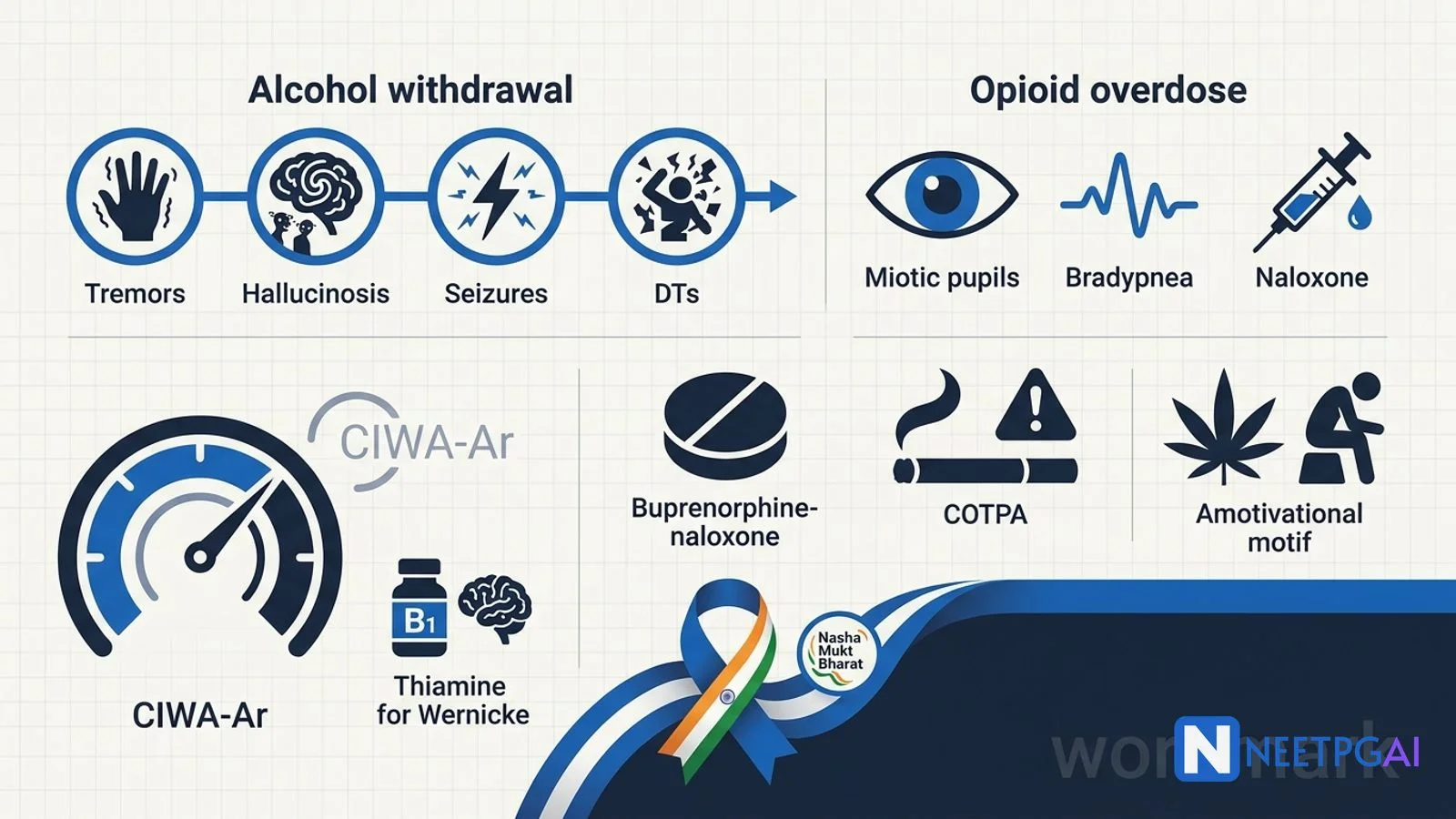
Substance use disorders (SUD) are a top-3 NEET PG psychiatry cluster — alcohol dominates the marks, opioid overdose recurs every year, and tobacco cessation is now a mandatory public-health question.
- DSM-5 SUD — one spectrum, 11 criteria; mild (2-3), moderate (4-5), severe (6+); dropped the abuse-vs-dependence split.
- Alcohol screening — CAGE (4 questions, cut-off 2), AUDIT (10 items, WHO gold standard), AUDIT-C (3 items — Indian primary-care workhorse).
- Withdrawal timeline — tremors 6-12 h → hallucinosis 12-24 h → seizures 24-48 h → delirium tremens 48-96 h (15-20 percent mortality untreated).
- CIWA-Ar guides diazepam or chlordiazepoxide dosing; lorazepam if liver failure.
- Wernicke encephalopathy — thiamine BEFORE glucose; triad ophthalmoplegia + ataxia + confusion (fewer than 20 percent have all three).
- Opioid overdose — miosis, bradypnea, coma; naloxone 0.4 mg IV/IM/IN, repeat every 2 minutes; monitor 4-6 h for re-narcotisation.
- Buprenorphine-naloxone (Suboxone) — India NAPDDR first-line; naltrexone only in the fully abstinent patient (7-10 days clean).
- Tobacco — 1.35 million Indian deaths/year; 5A framework; varenicline is the single most effective drug (psychiatric warning); COTPA Act 2003 and the 85 percent pack warning are the policy levers.
Substance use disorders sit at the intersection of psychiatry, internal medicine and public health, and NEET PG examiners exploit every seam. Alcohol drives cirrhosis, cardiomyopathy, pancreatitis and neuropathy; opioids drive overdose deaths and a growing prescription-tramadol crisis; tobacco drives 1.35 million preventable Indian deaths every year; and cannabis and stimulants underlie an emerging youth-mental-health problem that AIIMS and INI-CET cases are starting to reflect.
This NEETPGAI guide walks through the DSM-5 SUD framework, drug-by-drug intoxication and withdrawal syndromes, the pharmacotherapy ladder for maintenance and cessation, and the India-specific programmes — Nasha Mukt Bharat Abhiyaan, NAPDDR, COTPA, and the AIIMS NDDTC network — that surface in exam vignettes.
The DSM-5 substance use disorder framework
DSM-5 (2013) collapsed the older DSM-IV split of substance abuse versus substance dependence into a single Substance Use Disorder spectrum. Diagnosis requires at least 2 of 11 criteria within 12 months.
| Cluster | Criterion |
|---|
| Impaired control | Larger amounts than intended; unsuccessful efforts to cut down; time spent obtaining or using; craving |
| Social impairment | Failure to fulfil role obligations; use despite social problems; giving up activities |
| Risky use | Use in physically hazardous situations; use despite known physical or psychological harm |
| Pharmacological | Tolerance; withdrawal |
Severity: mild (2-3 criteria), moderate (4-5), severe (6 or more).
Tolerance and withdrawal are not counted for individuals on prescribed medications where the phenomena are expected (opioid analgesia, benzodiazepine anxiolysis).
Screening tools examiners test:
- CAGE — 4 items (Cut down, Annoyed, Guilty, Eye-opener); a score of 2 or more is a positive screen.
- AUDIT — 10 items; the WHO gold standard; identifies hazardous drinkers before dependence sets in.
- AUDIT-C — 3-item quick screen used in Indian PHCs.
- Fagerström Test for Nicotine Dependence — the standard tobacco severity score; high scores predict withdrawal and guide NRT dose.
- DAST-10 — drug abuse screening test for non-alcohol substances.
Alcohol use disorder — intoxication, withdrawal and pharmacotherapy
Alcohol is the most-tested substance on NEET PG psychiatry. India carries a heavy burden — Tamil Nadu, Kerala, Punjab and the Northeast lead consumption, and ICMR de-addiction data show rising treatment-seeking through the AIIMS NDDTC (National Drug Dependence Treatment Centre) network.
Acute intoxication
CNS depression progresses with blood alcohol level — disinhibition, ataxia and slurred speech at moderate levels; stupor, respiratory depression and hypoglycaemia at high levels. Management is supportive — airway protection, thiamine, glucose (after thiamine in the chronic user), and correction of electrolytes.
Withdrawal timeline
| Onset | Syndrome | Features |
|---|
| 6-12 h | Minor withdrawal | Tremor, anxiety, insomnia, headache, sweating, palpitations |
| 12-24 h | Alcoholic hallucinosis | Visual/tactile hallucinations with clear sensorium (contrast with DT) |
| 24-48 h | Withdrawal seizures | Generalised tonic-clonic; usually 1-2 isolated events |
| 48-96 h | Delirium tremens | Clouded sensorium, disorientation, agitation, autonomic storm, vivid visual hallucinations; 15-20 percent mortality untreated |
CIWA-Ar and benzodiazepine strategy
The Clinical Institute Withdrawal Assessment for Alcohol — Revised (CIWA-Ar) is a 10-item bedside score:
- Score less than 8 — supportive care
- Score 8-15 — symptom-triggered benzodiazepine dosing
- Score 15 or more — scheduled dosing plus close observation (HDU/ICU bed)
First-line agents:
- Chlordiazepoxide 50-100 mg orally every 6 hours, tapered over 5-7 days — the traditional Indian de-addiction workhorse
- Diazepam 10-20 mg IV/PO (long half-life provides self-tapering)
- Lorazepam or oxazepam if significant liver dysfunction (bypass hepatic oxidation — glucuronidation only)
Adjuncts:
- Thiamine 200 mg IV daily for 3-5 days, then oral 100 mg — always before glucose
- Folate 5 mg, magnesium sulphate correction, phosphate replacement
- Antipsychotic (haloperidol) only for refractory agitation — lowers seizure threshold and prolongs QT, so use cautiously
Wernicke-Korsakoff spectrum
- Wernicke encephalopathy — acute thiamine deficiency; classic triad of ophthalmoplegia (bilateral abducens palsy or nystagmus), ataxia, and confusion; fewer than 20 percent show all three, so treat empirically.
- Korsakoff syndrome — the untreated aftermath; permanent anterograde amnesia with confabulation from bilateral mammillary-body damage.
- Thiamine 500 mg IV three times a day for 2-3 days, then 250 mg daily for 5 days, then oral maintenance — protocol used in AIIMS and NIMHANS.
Systemic alcohol complications
- Alcoholic hepatitis (Maddrey discriminant function greater than 32 → prednisolone; MELD score for prognosis)
- Cirrhosis — commonest indication for liver transplant listing in urban India
- Pancreatitis — acute recurrent → chronic calcific pancreatitis
- Dilated cardiomyopathy — reversible with abstinence
- Peripheral neuropathy — thiamine-responsive, glove-and-stocking pattern
- Cerebellar degeneration — vermis atrophy, wide-based gait
Long-term maintenance pharmacotherapy
| Drug | Mechanism | India note |
|---|
| Naltrexone | Mu-opioid antagonist — reduces craving and reward | First-line; 50 mg PO daily; check LFT baseline |
| Acamprosate | Glutamate modulator (NMDA antagonism + GABA agonism) | Renally excreted — avoid in renal failure |
| Disulfiram | Aldehyde dehydrogenase inhibitor → alcohol-induced flushing, nausea | Requires motivated patient and abstinence; supervised dosing helps adherence |
| Baclofen | GABA-B agonist | Useful in patients with liver disease (safer profile) |
| Gabapentin | Alpha-2-delta calcium channel modulator | Adjunct for anxiety and insomnia in early abstinence |
Opioid use disorder — from heroin to prescription tramadol
India's opioid landscape has shifted from heroin (brown sugar) dominance to a broader mix including prescription oxycodone, tramadol misuse and emerging fentanyl (currently a smaller footprint than the US crisis).
Intoxication
- Triad — miosis (pinpoint pupils), bradypnea, drowsiness
- Progression — coma, apnoea, hypotension, aspiration
- Distinguish from clonidine and organophosphate poisoning (both cause miosis; organophosphate adds SLUDGE/M and fasciculations)
Overdose reversal
- Naloxone 0.4 mg IV, IM or intranasal, repeat every 2 minutes to a maximum of 10 mg
- Short half-life (30-90 minutes) — the patient can re-narcotise; observe 4-6 hours after full-agonist overdose, longer for long-acting opioids (methadone) — may need naloxone infusion
- India naloxone access is expanding through NAPDDR harm-reduction outreach, but community availability remains limited
- Bystander-naloxone is now legal under Schedule H1 revisions
Withdrawal syndrome
Uncomfortable but not life-threatening (contrast with alcohol and benzodiazepine withdrawal):
- Piloerection ("cold turkey"), rhinorrhoea, lacrimation, yawning
- Mydriasis, diarrhoea, muscle aches, abdominal cramps
- Dysphoria, restlessness, insomnia
- Timeline — short-acting opioids peak at 36-72 hours; methadone withdrawal peaks at 3-8 days
Objective severity is graded by the Clinical Opiate Withdrawal Scale (COWS) — symptom-triggered clonidine, loperamide, dicyclomine and ibuprofen; buprenorphine induction when COWS is above 12.
Maintenance pharmacotherapy
| Drug | Mechanism | India context |
|---|
| Methadone | Full mu-agonist, long-acting | Limited to a handful of PHC pilots and NDDTC sites |
| Buprenorphine-naloxone (Suboxone) | Partial mu-agonist + antagonist deterrent | Workhorse of NAPDDR; expanding through district de-addiction centres |
| Naltrexone | Mu-antagonist | Abstinent patient only (7-10 days clean) — precipitates withdrawal otherwise; depot injection improves adherence |
Tobacco — the biggest preventable killer in India
Tobacco causes 1.35 million Indian deaths per year (Global Adult Tobacco Survey / ICMR). India has 267 million users — 100 million smokers (bidis dominant) and over 200 million smokeless-tobacco users (gutka, khaini, zarda). Smokeless tobacco drives oral cancer, and bidis drive COPD and lung cancer.
Screening and severity
- Fagerström Test for Nicotine Dependence — 6 items scoring 0-10; higher scores predict withdrawal severity and NRT dose
- Time to first cigarette after waking is the single strongest predictor of dependence (under 5 minutes = severe)
The 5A framework (WHO and MoHFW)
- Ask — screen every patient at every visit
- Advise — clear, personalised quit message
- Assess — readiness to quit
- Assist — counselling and pharmacotherapy
- Arrange — schedule follow-up
Pharmacotherapy
| Drug | Mechanism | Notes |
|---|
| Nicotine replacement therapy | Nicotinic agonist (partial substitution) | Patches for baseline + gum/lozenge for breakthrough craving; safe in stable CAD |
| Varenicline (Chantix) | Partial alpha-4 beta-2 nicotinic receptor agonist | Most effective monotherapy; neuropsychiatric warning — mood assessment before starting |
| Bupropion | Norepinephrine-dopamine reuptake inhibitor | Seizure warning — avoid in epilepsy, eating disorders, benzodiazepine withdrawal |
| Combination NRT | Patch + short-acting NRT | Beats monotherapy in heavy smokers |
India policy levers
- COTPA Act 2003 — Cigarettes and Other Tobacco Products Act; smoke-free public places, no advertising, no under-18 sale
- 85 percent pictorial pack warning — one of the world's most stringent
- Smokeless tobacco ban — state-level; enforcement variable
- Tobacco-Free Youth Campaign 2.0 — MoHFW school programme
- mCessation — SMS-based cessation programme reaching 5+ million users
Cannabis, stimulants, hallucinogens and benzodiazepine misuse
Cannabis
India has a complicated legal position — bhang is legal under the Narcotic Drugs and Psychotropic Substances Act, while charas and ganja are illegal. Use is rising rapidly in urban youth.
- Acute intoxication — impaired coordination, conjunctival injection ("red eyes"), tachycardia, increased appetite, paranoia, time distortion; occasional acute psychosis in the vulnerable
- Chronic use — amotivational syndrome (blunted drive, apathy), psychosis risk in genetically vulnerable adolescents (adolescent use before age 15 doubles psychosis risk)
- Withdrawal — irritability, insomnia, anxiety, decreased appetite; usually days 2-7 after cessation
- No specific FDA-approved pharmacotherapy — CBT and motivational enhancement are the mainstays
Stimulants (cocaine, methamphetamine, MDMA)
Cocaine use is uncommon in India; methamphetamine is emerging (Northeast trafficking corridor and Rx-misuse); MDMA is a party-drug problem in metros.
- Intoxication — sympathomimetic surge — euphoria, tachycardia, hypertension, hyperthermia, agitation; can progress to seizure, MI, stroke, aortic dissection, hyperthermia-induced rhabdomyolysis
- MDMA-specific — hyperthermia, hyponatraemia (from psychogenic polydipsia + SIADH), serotonin syndrome
- Treatment — supportive; benzodiazepines first-line for agitation, hypertension, hyperthermia and seizure; active cooling for hyperthermia; avoid pure beta-blockers (unopposed alpha-adrenergic vasoconstriction worsens hypertension); use combined alpha-beta blockers (labetalol) if needed
Hallucinogens
LSD, psilocybin (magic mushrooms) and ketamine (dissociative) — bad trips managed with reassurance ("talk-down"), quiet environment and benzodiazepines. Hallucinogen Persisting Perception Disorder (HPPD) — recurrent visual disturbances (flashbacks) after use.
Benzodiazepine misuse
- Dependence develops within 4-6 weeks of daily use
- Withdrawal mirrors alcohol — anxiety, tremor, insomnia, seizures, delirium — potentially fatal
- Taper slowly with a long-acting agent (diazepam) over weeks to months; never abrupt stop
- Flumazenil is rarely used to reverse overdose because it can precipitate seizures in chronic users
Comorbidity, screening and India-specific programmes
SUD rarely travels alone. Common comorbidities that examiners test:
- Depression — self-medication hypothesis; integrated dual-diagnosis treatment beats sequential care
- Anxiety and PTSD — alcohol and benzodiazepine misuse
- ADHD — stimulant misuse
- Bipolar disorder — cannabis and stimulant misuse
- Schizophrenia — tobacco use rates near 80 percent; cannabis worsens psychosis
- HIV, hepatitis B, hepatitis C — injection drug use
SBIRT
Screening, Brief Intervention, Referral to Treatment — the WHO model for opportunistic SUD identification in primary care. India NAPDDR training rolls SBIRT out through PHCs.
Indian programmes and centres
- Nasha Mukt Bharat Abhiyaan (NMBA) — Ministry of Social Justice and Empowerment national campaign since 2020
- NAPDDR (National Action Plan for Drug Demand Reduction) — five-year framework (2018-2025); harm reduction, buprenorphine expansion, OOAT (Outpatient Opioid Assisted Treatment) clinics
- AIIMS NDDTC — National Drug Dependence Treatment Centre, Ghaziabad; India's tertiary de-addiction referral centre
- NIMHANS — Bengaluru; runs the Centre for Addiction Medicine and dual-diagnosis clinics
- ICMR National Mental Health Survey — provides SUD prevalence data used in every AIIMS SPM paper
NEET PG MCQ traps
- DSM-5 SUD severity — 2-3 mild, 4-5 moderate, 6+ severe.
- CAGE cut-off — 2 or more is a positive screen.
- Alcohol withdrawal seizures — 24-48 hours after last drink.
- Delirium tremens — 48-96 hours; mortality 15-20 percent untreated.
- Alcoholic hallucinosis — 12-24 hours, clear sensorium (contrast with DT).
- Thiamine before glucose — always, in the chronic alcohol user.
- Wernicke triad — ophthalmoplegia, ataxia, confusion; fewer than 20 percent show all three.
- Korsakoff — anterograde amnesia with confabulation; mammillary body damage.
- Chlordiazepoxide — standard Indian de-addiction benzodiazepine; switch to lorazepam or oxazepam in liver failure.
- Naltrexone — mu-opioid antagonist; used for alcohol AND for opioid abstinence — but only after 7-10 days opioid-free.
- Acamprosate — renally excreted; avoid in renal failure.
- Disulfiram — aldehyde dehydrogenase inhibitor; flushing, nausea, hypotension with alcohol.
- Opioid overdose triad — miosis, bradypnea, coma.
- Naloxone dose — 0.4 mg IV/IM/IN, repeat every 2 minutes; monitor 4-6 hours.
- Buprenorphine-naloxone — partial agonist plus deterrent naloxone; NAPDDR first-line India.
- Methadone — full mu-agonist; India access limited to NDDTC and PHC pilots.
- Fagerström — tobacco dependence score; time to first cigarette is the strongest single item.
- Varenicline — most effective smoking cessation drug; neuropsychiatric warning.
- Bupropion — seizure warning; avoid in epilepsy and eating disorders.
- Cannabis withdrawal — irritability, insomnia, decreased appetite; no approved pharmacotherapy.
- Stimulant intoxication — benzodiazepines first-line; avoid pure beta-blockers.
- MDMA — hyperthermia and hyponatraemia; active cooling is life-saving.
- Benzodiazepine withdrawal — taper with long-acting agent; abrupt stop causes seizures and delirium.
- COTPA Act 2003 — regulates cigarettes and other tobacco products in India.
- Nasha Mukt Bharat — the current national anti-drug campaign.
Key takeaways
- Substance use disorders are a DSM-5 spectrum — remember the four criterion clusters and the mild/moderate/severe cut-offs.
- Alcohol withdrawal has a predictable clock — the 6-hour, 24-hour, and 96-hour landmarks are the exam anchors.
- Give thiamine before glucose. Every time. In every chronic alcohol user.
- Naloxone reverses opioid overdose but doesn't outlast the opioid — observe.
- Buprenorphine-naloxone is India's opioid maintenance backbone; naltrexone waits for abstinence.
- Varenicline is the strongest cessation drug but needs a psychiatric-safety check.
- Public-health knowledge (COTPA, Nasha Mukt Bharat, NAPDDR, 5A framework, ICMR NMHS) is now testable in the SPM and psychiatry buckets alike.
Frequently asked questions
How does DSM-5 classify substance use disorder severity and how is alcohol use disorder screened in India?
DSM-5 collapsed the older abuse-versus-dependence dichotomy into a single Substance Use Disorder spectrum with 11 diagnostic criteria across four clusters — impaired control, social impairment, risky use, and pharmacological (tolerance and withdrawal). Severity is graded by criterion count — mild (2-3), moderate (4-5), and severe (6 or more). For alcohol screening the classic 4-item CAGE questionnaire (Cut down, Annoyed by criticism, Guilty, Eye-opener) is a fast bedside filter — a score of 2 or more is a positive screen. The 10-item AUDIT (Alcohol Use Disorders Identification Test) developed by WHO is more sensitive and specific and detects hazardous use before dependence sets in. The abbreviated 3-item AUDIT-C is widely used in Indian primary care and de-addiction outreach programmes because it captures the frequency, quantity, and binge pattern in under two minutes.
What is the timeline of alcohol withdrawal and when should CIWA-Ar-guided treatment escalate?
Alcohol withdrawal follows a predictable timeline in the dependent drinker who abruptly stops or reduces intake. From 6-12 hours — minor withdrawal with tremors, anxiety, insomnia, headache, sweating, palpitations, and mild autonomic hyperactivity. From 12-24 hours — alcoholic hallucinosis, typically visual or tactile hallucinations with a clear sensorium (distinguishing it from DT). From 24-48 hours — withdrawal seizures, generalised tonic-clonic, usually one or two isolated events but occasionally status epilepticus. From 48-96 hours — delirium tremens with clouded sensorium, disorientation, agitation, autonomic storm, and vivid visual hallucinations; untreated DT carries a 15-20 percent mortality. The CIWA-Ar (Clinical Institute Withdrawal Assessment for Alcohol — Revised) is a 10-item score used to titrate benzodiazepine therapy — scores below 8 need supportive care only, 8-15 need symptom-triggered benzodiazepines, and 15 or more require scheduled benzodiazepine dosing plus close monitoring in a step-down or ICU bed. Diazepam and chlordiazepoxide are the standard long-acting agents; lorazepam or oxazepam replace them in significant liver disease because they bypass hepatic oxidation.
Why must thiamine be given before glucose in a suspected Wernicke encephalopathy patient?
Wernicke encephalopathy is an acute thiamine (vitamin B1) deficiency syndrome classically producing the triad of confusion, ophthalmoplegia (bilateral abducens palsy or nystagmus), and ataxia — though fewer than 20 percent of patients show all three. Chronic alcohol use disorder is the commonest Indian cause because ethanol impairs thiamine absorption, hepatic storage, and phosphorylation to the active TPP cofactor. Giving glucose before thiamine to a thiamine-depleted patient rapidly consumes what little cofactor remains — driving pyruvate through glycolysis without a functional TPP-dependent pyruvate dehydrogenase — and can precipitate or worsen Wernicke encephalopathy or convert it into permanent Korsakoff syndrome (anterograde amnesia with confabulation). The standard protocol is thiamine 200-500 mg IV every 8 hours for 2-3 days, followed by oral maintenance, always before any glucose infusion in a suspected chronic alcohol user, cachectic patient, or hyperemesis gravidarum case. NEET PG tests this order-of-operations principle repeatedly.
How does buprenorphine differ from methadone and naltrexone in opioid use disorder maintenance?
The three approved opioid use disorder pharmacotherapies work through different mechanisms. Methadone is a long-acting full mu-opioid agonist that stabilises the endogenous opioid system, blunts craving, and blocks the euphoria of illicit opioids. It requires daily supervised dosing at licensed clinics (limited in India — a handful of AIIMS and NDDTC sites), carries QT-prolongation and respiratory-depression risks, and interacts widely via CYP3A4. Buprenorphine is a partial mu-opioid agonist with a ceiling effect on respiratory depression — much safer in overdose — and is dispensed as a combination sublingual tablet with naloxone (Suboxone) to deter injection misuse (naloxone is inert orally but precipitates withdrawal if injected). Buprenorphine is the workhorse of India's NAPDDR programme with rapid expansion through district de-addiction centres. Naltrexone is a mu-opioid antagonist that blocks the euphoric effect of any opioid; it is only started in the fully abstinent patient (at least 7-10 days opioid-free) because it precipitates severe withdrawal in an active user. Long-acting depot naltrexone improves adherence in motivated abstinent patients.
What is the WHO 5A framework for tobacco cessation and what pharmacotherapy options are effective?
The 5A framework is the WHO and India MoHFW-endorsed brief-intervention model for tobacco cessation in every clinical encounter — Ask (screen every patient), Advise (deliver a clear personalised quit message), Assess (readiness to quit), Assist (offer counselling and pharmacotherapy), and Arrange (schedule follow-up). Pharmacotherapy triples quit rates. Nicotine replacement therapy is the first line — patches for baseline craving control combined with faster-acting gum or lozenge for breakthrough craving; safe in most patients including those with stable cardiovascular disease. Varenicline (a partial nicotinic acetylcholine receptor agonist) is the single most effective monotherapy but carries a boxed warning for neuropsychiatric adverse effects — assess mood before starting and monitor. Bupropion is a norepinephrine-dopamine reuptake inhibitor with a seizure warning — avoid in epilepsy, eating disorders, or benzodiazepine withdrawal. Combination therapy (patch plus short-acting NRT, or varenicline plus NRT) beats monotherapy in heavy smokers. India's COTPA Act 2003, the 85 percent pictorial pack warning, and the smokeless tobacco ban are complementary population-level levers.
This content is for educational purposes for NEET PG exam preparation. It is not a substitute for professional medical advice, diagnosis, or treatment. Clinical information has been reviewed by qualified medical professionals.
Written by: NEETPGAI Editorial Team
Reviewed by: Pending SME Review
Last reviewed: July 2026