Updated 23 November 2026
Quick Answer
Choose regional anaesthesia when the surgery is below the umbilicus or on a limb, the airway or aspiration risk is worrying, and nothing contraindicates a block. Choose general anaesthesia for upper abdominal, thoracic, spine and head surgery, or when neuraxial is contraindicated (coagulopathy, sepsis at the site, refusal, raised ICP). Caesarean section defaults to spinal.
How do you decide between regional and general anaesthesia?
Most exam stems in this area are decisions, not recall: which technique, which drug, what went wrong. The decision itself is simpler than coaching notes make it look. Ask three questions in order.
First, is neuraxial contraindicated? Patient refusal, infection at the puncture site, uncorrected coagulopathy or anticoagulation, raised ICP from a mass lesion and severe hypovolaemia all push you to GA. Tight aortic stenosis is a strong relative contraindication because a sudden sympathectomy removes the preload the heart depends on; a slowly titrated epidural is sometimes used, but a single-shot spinal is the wrong answer in a stem.
Second, can a block cover the operation? Lower abdomen, perineum and lower limbs, yes. Upper abdomen, chest, spine and head, no: those need GA with an endotracheal tube, often with an epidural added for pain relief afterwards.
Third, is the airway or aspiration risk the real danger? If so, and a block can cover the surgery, regional wins. That is the whole logic behind spinal for Caesarean section.
One honest caveat: for hip fracture surgery, the textbook line that spinal beats GA on outcomes is weaker than it looks. The REGAIN trial (NEJM 2021) found no meaningful difference in ambulation or survival at 60 days between the two. Spinal still reduces blood loss and DVT in older data, and exams still accept spinal as the preferred answer, but don't assume it is clearly superior.
Spinal anaesthesia: site, needle, drugs and block height
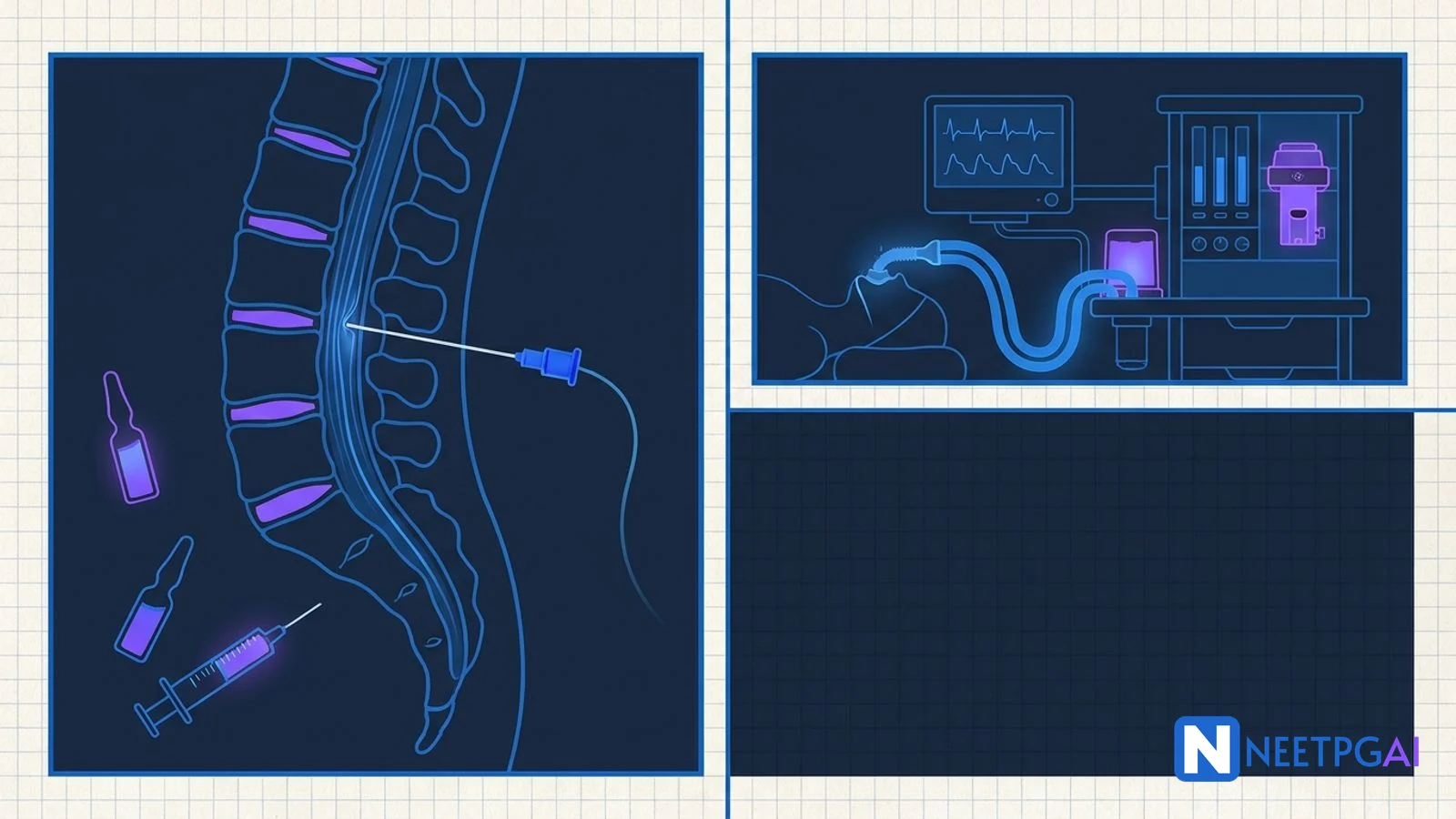
Spinal (subarachnoid) block is a single injection into the CSF at L3-L4 or L4-L5, safely below the conus medullaris, which ends at about L1-L2 in adults. In the midline approach the needle passes skin, subcutaneous tissue, supraspinous ligament, interspinous ligament, ligamentum flavum, dura and arachnoid; free flow of clear CSF confirms the position.
Use a 25-27 G pencil-point needle (Whitacre or Sprotte) where you can. It separates dural fibres instead of cutting them, so the headache rate is much lower than with a cutting Quincke needle.
| Drug | Typical dose | Notes |
|---|
| Bupivacaine 0.5% hyperbaric | 2-3 mL (10-15 mg) | Workhorse; lasts about 90-180 min |
| Bupivacaine 0.5% isobaric | 2.5-3 mL | Spread less dependent on posture |
| Lidocaine 5% hyperbaric | Avoided | Transient neurological symptoms |
| Fentanyl (adjuvant) | 10-25 mcg | Faster, better sensory block |
| Morphine (adjuvant) | 100-300 mcg | 18-24 h analgesia; watch for late respiratory depression |
Block height is a frequent one-mark question. These levels follow Morgan and Mikhail's Clinical Anesthesiology:
| Operation | Sensory level needed |
|---|
| Caesarean section, upper abdominal surgery | T4 (nipple) |
| Lower abdominal surgery (appendicectomy, hernia) | T6 (xiphisternum) |
| TURP, vaginal delivery, hip surgery | T10 (umbilicus) |
| Thigh and lower leg | L1 |
| Foot and ankle | L2 |
| Perineal and perianal surgery | S2-S5 (saddle block) |
Spinal gives a fast onset (2-5 minutes), a dense sensory and motor block and an awake patient with a tiny drug dose. The price is a fixed duration, hypotension from the sympathectomy, and the risk of post-dural puncture headache.
Epidural and combined spinal-epidural: what the catheter adds
An epidural uses a 16-18 G Tuohy needle to find the epidural space by loss of resistance, usually to saline rather than air, and leaves a catheter 3-5 cm inside. Lumbar epidurals cover the lower abdomen and legs; thoracic epidurals are placed for upper abdominal and chest surgery, mainly for postoperative pain.
| Drug | Concentration | Typical use |
|---|
| Bupivacaine | 0.0625-0.5% | 10-20 mL bolus for surgery; 5-10 mL/h infusion for labour |
| Ropivacaine | 0.1-0.75% | Similar, slightly less motor block and cardiotoxicity |
| Fentanyl (adjuvant) | 1-5 mcg/mL | Added to dilute infusions |
The trade-off with spinal is clear. Epidural onset is slower (10-20 minutes), the block is less dense and failure or patchiness is more common, but you can extend it for days and limit it to the segments you need. Accidental dural puncture with the large Tuohy needle is uncommon (often quoted around 1% in obstetric practice) but gives a nasty headache when it happens.
Combined spinal-epidural (CSE) gets you both. The Tuohy finds the epidural space, a long 25-27 G spinal needle goes through it to deliver a small intrathecal dose, the spinal needle comes out and the catheter goes in. It is used for long lower-limb operations, some Caesareans and labour analgesia.
General anaesthesia drugs: induction, relaxation and maintenance
Induction agents
| Agent | Dose | Strength | Weakness | Stem that wants it |
|---|
| Propofol | 1.5-2.5 mg/kg | Smooth, fast emergence, antiemetic | Hypotension, apnoea, injection pain | Routine elective adult, day case |
| Thiopental | 3-5 mg/kg | Lowers ICP, anticonvulsant | Hypotension, histamine release, no analgesia | Neurosurgery, refractory status epilepticus |
| Etomidate | 0.2-0.3 mg/kg | Cardiovascular stability | Adrenal suppression, myoclonus, PONV | Cardiac disease, shock |
| Ketamine | 1-2 mg/kg IV, 4-6 mg/kg IM | Raises BP, bronchodilates, keeps airway reflexes | Emergence delirium, raises IOP | Haemorrhagic shock, asthma, uncooperative child |
Ketamine has traditionally been avoided in head injury because of raised ICP. More recent work suggests the effect is small when ventilation is controlled, and guidance is softening, but in an exam stem with head injury, ketamine is still usually the wrong pick. Etomidate in sepsis is similarly argued over because of adrenal suppression after even one dose.
Muscle relaxants
Succinylcholine (1-1.5 mg/kg) is the only depolarising relaxant in use. It has the fastest onset (30-60 seconds) and shortest action (5-10 minutes), which is why it is the RSI classic. It is contraindicated in hyperkalaemia, burns and crush injury beyond the first day or so, denervation injury and muscular dystrophy (hyperkalaemic arrest), and in known malignant hyperthermia susceptibility. Pseudocholinesterase deficiency prolongs its action.
| Non-depolarising drug | Dose | Duration | Elimination |
|---|
| Rocuronium | 0.6-1.2 mg/kg | 30-45 min | Mainly hepatic |
| Vecuronium | 0.08-0.1 mg/kg | 30-45 min | Hepatic and renal |
| Atracurium | 0.5 mg/kg | 20-35 min | Hofmann elimination and ester hydrolysis |
| Cisatracurium | 0.15 mg/kg | 35-45 min | Hofmann elimination |
Atracurium and cisatracurium don't depend on liver or kidney, so they are the answer for a patient with organ failure. Reversal is neostigmine 0.04-0.07 mg/kg with glycopyrrolate, or sugammadex 2-4 mg/kg for rocuronium and vecuronium.
Maintenance
| Agent | MAC (%) | Character |
|---|
| Isoflurane | 1.17 | Cheap, pungent, slower emergence |
| Sevoflurane | 2.0 | Non-pungent, so the inhalational induction agent of choice in children |
| Desflurane | 6.0 | Fastest emergence, too pungent for induction |
| Nitrous oxide | 104 | Cannot be used alone; carrier gas, second-gas effect |
Every volatile agent triggers malignant hyperthermia; nitrous oxide does not. Total intravenous anaesthesia with a propofol infusion (around 100-200 mcg/kg/min) replaces volatiles in MH-susceptible patients and those at high PONV risk.
Which anaesthetic for which operation?
| Surgery | Usual choice | Alternative or add-on |
|---|
| Elective Caesarean | Spinal (hyperbaric bupivacaine 1.6-2 mL with fentanyl and morphine) | CSE if prolonged; epidural top-up if a labour epidural is in |
| Crash Caesarean, or neuraxial contraindicated | GA with RSI | Spinal if time genuinely allows |
| Lower-limb orthopaedics | Spinal | Femoral and sciatic blocks |
| Hip fracture or arthroplasty | Spinal or GA | Fascia iliaca block for analgesia |
| Shoulder surgery | Interscalene block with or without GA | GA alone |
| Arm, forearm, hand | Supraclavicular or axillary brachial plexus block | GA with LMA |
| Spine surgery | GA (prone, airway secured) | None |
| Appendicectomy, hernia | Spinal (T6) | GA |
| Open upper abdominal surgery | GA with tube | Thoracic epidural for pain |
| Laparoscopic surgery | GA with tube | None |
| Thoracotomy | GA with double-lumen tube | Thoracic epidural or paravertebral block |
| Craniotomy | GA (often TIVA) | None |
Two details examiners like: the interscalene block reliably blocks the ipsilateral phrenic nerve, so avoid it in patients with poor respiratory reserve, and it tends to spare the ulnar territory (C8-T1). For a GA Caesarean, the package is RSI, left uterine displacement and aspiration prophylaxis (sodium citrate, an H2 blocker or PPI, and metoclopramide). The airway side of RSI is covered in the guide to the difficult airway algorithm.
Complications that show up in exam stems
Post-dural puncture headache
A bilateral fronto-occipital headache, worse sitting or standing and eased lying flat, usually starting within 2-3 days of dural puncture. Neck stiffness, nausea, photophobia and tinnitus can come with it. CSF leaks out faster than it is made (about 500 mL a day), the brain sags when upright, and compensatory venous dilatation adds to the pain.
Risk rises with bigger and cutting needles, young age, female sex and pregnancy. Published rates vary a lot between studies; the ranking is what exams test. An accidental 16-18 G Tuohy puncture is worst (roughly half or more), cutting Quincke needles are intermediate, and fine pencil-point needles are lowest at a few percent or less.
Treat conservatively first: fluids, paracetamol or an NSAID, and caffeine. Bed rest makes the patient comfortable but does not prevent PDPH. If the headache is severe or lasts beyond 24-48 hours, the epidural blood patch is definitive: 15-20 mL of the patient's own blood injected into the epidural space at or one level below the puncture. Most series report success after one patch in the majority of patients, and a second patch is reasonable if the first fails.
Local anaesthetic systemic toxicity (LAST)
Symptoms classically march from perioral tingling, metallic taste, tinnitus and agitation to seizures, then coma, arrhythmias and asystole. Bupivacaine breaks that order: it can cause cardiovascular collapse with little neurological warning because it leaves cardiac sodium channels so slowly.
| Drug | Maximum plain | With adrenaline |
|---|
| Lidocaine | 4.5 mg/kg | 7 mg/kg |
| Bupivacaine | 2.5 mg/kg | 3 mg/kg |
| Ropivacaine | 3 mg/kg | Not usually quoted |
| Levobupivacaine | 2 mg/kg | Not usually quoted |
Management follows the ASRA checklist:
- Stop injecting, call for help, give 100% oxygen and protect the airway.
- Treat seizures with a benzodiazepine (midazolam or diazepam). Avoid large doses of propofol in an unstable patient.
- Start 20% lipid emulsion: 1.5 mL/kg bolus over 2-3 minutes, then about 0.25 mL/kg/min. Repeat the bolus once or twice for persistent collapse. Older guidance capped the total at about 10 mL/kg over 30 minutes; the current ASRA checklist gives an upper limit of roughly 12 mL/kg.
- Modify ACLS: small adrenaline doses (1 mcg/kg or less), and no vasopressin, calcium channel blockers, beta-blockers or lidocaine. Amiodarone is the antiarrhythmic.
- Arrange cardiopulmonary bypass or ECMO if arrest persists.
The lipid is thought to act as a sink that pulls bupivacaine out of cardiac tissue. Lipid rescue grew out of Weinberg's animal work, which is why exams still name him.
High or total spinal
Excess cephalad spread of intrathecal drug gives profound hypotension, bradycardia, arm weakness, then apnoea once C3-C5 (phrenic) is reached and loss of consciousness. Treat with airway and ventilation, fluids, vasopressors and atropine. It usually wears off as the drug does.
Malignant hyperthermia
A hypermetabolic crisis in genetically susceptible patients given a volatile agent or succinylcholine. The earliest sign is a rising end-tidal CO2 despite more ventilation, often with tachycardia and masseter spasm. Fever is late. Give dantrolene 2.5 mg/kg IV, repeated up to about 10 mg/kg, stop the trigger, cool, and treat hyperkalaemia and acidosis.
Awareness under anaesthesia
Explicit recall during GA. Textbooks quote 1-2 per 1,000 general anaesthetics from structured interviews, while the UK NAP5 audit found about 1 in 19,000 from spontaneous reports; the gap reflects how you ask. Risk is highest with paralysis plus too little hypnotic: obstetric GA, cardiac surgery, TIVA without monitoring. BIS monitoring targets 40-60.
PONV
The Apfel score counts four risk factors: female sex, non-smoker, previous PONV or motion sickness, and postoperative opioids. Prophylaxis with ondansetron 4 mg plus dexamethasone 4-8 mg covers most patients; propofol TIVA reduces risk further.
Four worked stems and where students slip
A 28-year-old with 40% burns three weeks ago needs debridement. Fast intubation is wanted. Succinylcholine is the trap; rocuronium is the answer, because extrajunctional receptors make suxamethonium dangerous.
A patient seizes 30 seconds after a supraclavicular block with bupivacaine, then becomes hypotensive. Benzodiazepine for the seizure, lipid emulsion for the circulation. A full 1 mg of adrenaline or lidocaine for the arrhythmia are both wrong.
A woman on therapeutic enoxaparin, last dose 14 hours ago, needs a hernia repair. Spinal is not safe yet: ASRA wants 24 hours after a therapeutic dose (12 after prophylactic). Delay or choose GA.
A 70-year-old with severe aortic stenosis and a hip fracture: single-shot spinal is the wrong choice. GA with careful haemodynamic control, or a slowly titrated epidural in experienced hands, is defensible. Drug interaction traps around these choices are covered in the INI-CET pharmacology drug interactions guide, and a broader set of anaesthesia errors sits in common anaesthesia mistakes for NEET PG.
Frequently Asked Questions
What is the difference between spinal and epidural anaesthesia?
Spinal anaesthesia is a single small dose of local anaesthetic injected into the CSF below the end of the cord, giving a dense block within about 5 minutes that lasts 1.5-3 hours. Epidural anaesthesia puts a larger volume into the epidural space, usually through a catheter, so it is slower (10-20 minutes) and less dense, but it can be topped up for hours or days and confined to chosen segments.
What is combined spinal epidural (CSE) anaesthesia?
CSE is a needle-through-needle technique. A Tuohy needle finds the epidural space, a long fine spinal needle is passed through it to give a small intrathecal dose, then the spinal needle is removed and an epidural catheter is threaded. You get the fast, dense onset of a spinal plus a catheter to extend the block. It suits long lower-limb surgery, some Caesareans and labour analgesia.
Why is spinal anaesthesia preferred for Caesarean section?
Spinal is preferred because it avoids the obstetric airway, which is harder to intubate and more prone to aspiration than a non-pregnant airway. The mother stays awake, the baby is exposed to very little drug, and intrathecal morphine gives about a day of analgesia. A block up to T4 is needed. GA is kept for neuraxial contraindications or a true crash section where there is no time.
When is spinal anaesthesia contraindicated?
Absolute contraindications are patient refusal, infection at the puncture site, uncorrected coagulopathy or full anticoagulation, raised intracranial pressure from a mass lesion, and severe uncorrected hypovolaemia. Tight aortic stenosis is a strong relative contraindication because the sudden sympathectomy drops preload. For LMWH, ASRA advises waiting 12 hours after a prophylactic dose and 24 hours after a therapeutic dose before neuraxial puncture.
Which induction agent is used in shock?
Etomidate and ketamine are the two answers, and the stem decides between them. Etomidate (0.2-0.3 mg/kg) barely changes blood pressure but suppresses adrenal steroid synthesis. Ketamine (1-2 mg/kg IV) raises heart rate and blood pressure through sympathetic stimulation and also bronchodilates, so it wins for haemorrhagic shock or an asthmatic in shock. Propofol is the wrong answer because it drops blood pressure.
Why is succinylcholine contraindicated in burns?
After a major burn, muscle membranes grow extra extrajunctional acetylcholine receptors, so succinylcholine causes a large potassium release that can trigger hyperkalaemic cardiac arrest. The risk starts roughly 24-48 hours after the burn and persists for months. The same mechanism applies to crush injury, denervation, prolonged immobilisation and muscular dystrophies. Use rocuronium instead, with sugammadex available for reversal.
What is post-dural puncture headache and how is it treated?
PDPH is a positional headache, worse sitting or standing and better lying flat, that follows a dural puncture, usually within 2-3 days. CSF leaking through the hole lowers CSF volume and drags on pain-sensitive structures. Treat first with fluids, simple analgesics and caffeine. If it is severe or persists beyond about 24-48 hours, an epidural blood patch of 15-20 mL autologous blood is the definitive treatment.
Which needle causes the least post-dural puncture headache?
A fine pencil-point needle such as a 25-27 G Whitacre or Sprotte causes the least PDPH, because it separates dural fibres rather than cutting them. Cutting Quincke needles carry a higher risk, and an accidental puncture with a 16-18 G Tuohy epidural needle carries the highest, affecting roughly half or more of patients. If a Quincke needle is used, keep the bevel parallel to the long axis of the spine.
What is the treatment for local anaesthetic systemic toxicity?
Stop the injection, call for help, give 100% oxygen and secure the airway, control seizures with a benzodiazepine, and start 20% lipid emulsion: 1.5 mL/kg bolus over 2-3 minutes followed by an infusion of about 0.25 mL/kg/min. Modify ACLS by keeping adrenaline doses at 1 mcg/kg or less and avoiding vasopressin, calcium channel blockers, beta-blockers and further local anaesthetic.
Why is bupivacaine more cardiotoxic than lidocaine?
Bupivacaine is more lipid-soluble and binds cardiac sodium channels quickly but releases them slowly, so the block accumulates beat by beat. That produces resistant ventricular arrhythmias and prolonged, difficult resuscitation. With lidocaine, seizures usually appear well before cardiovascular collapse; with bupivacaine, cardiac toxicity can arrive with little neurological warning. That is why its maximum dose is lower, about 2.5 mg/kg plain.
What is the earliest sign of malignant hyperthermia?
A rising end-tidal CO2 that does not respond to increased ventilation is the earliest sign, often with unexplained tachycardia and masseter rigidity after succinylcholine. Temperature rise is a late sign, which is the classic trap. Treatment is to stop the volatile agent, hyperventilate with 100% oxygen, and give dantrolene 2.5 mg/kg IV, repeated up to about 10 mg/kg, while cooling and treating hyperkalaemia.
Practise the regional versus general call
These questions reward pattern recognition more than memory, so the fastest way to get them right is volume: twenty stems on contraindications and complications will teach you more than another reread of the tables. Anaesthesia questions in the practice section are free for every registered user, and the companion article on anaesthesia induction, airway and monitoring fills in capnography and monitoring. If you haven't yet, sign up free and run a short anaesthesia block tonight.