Quick Answer
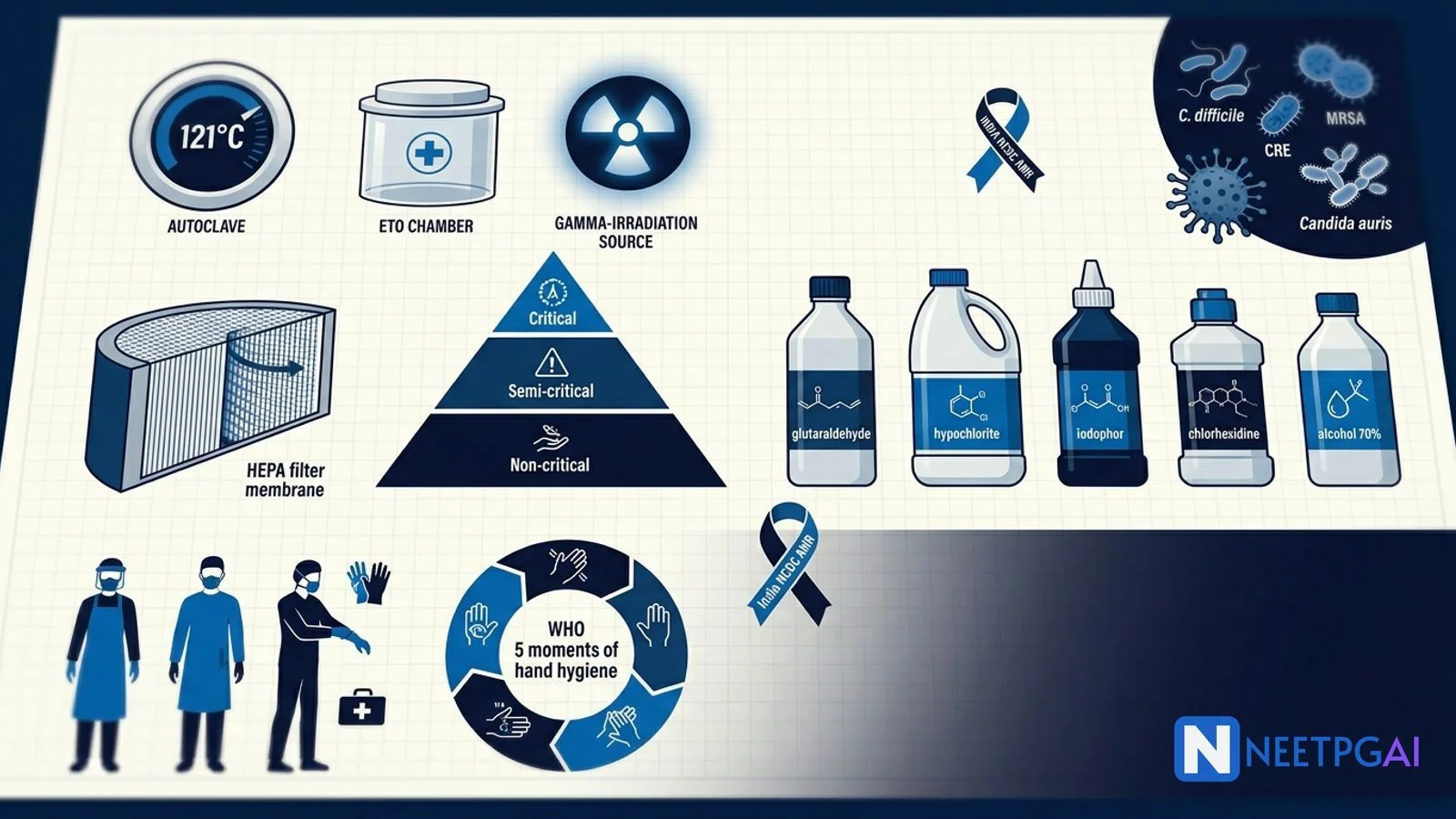
Sterilization, disinfection and hospital infection control is a compact but heavily tested NEET PG microbiology chapter — it appears at INI-CET, JIPMER and AIIMS, and increasingly in patient safety questions under NABH accreditation frameworks. Master these seven anchors.
- Sterilization kills all microbes including spores. Disinfection kills vegetative pathogens (spores may survive). Antisepsis is chemical use on living tissue.
- Spaulding classification — critical (sterile sites, must sterilise), semi-critical (mucous membranes, high-level disinfection), non-critical (intact skin, low-level).
- Autoclave — 121 degrees Celsius, 15 psi, 15 to 30 minutes; gold standard; biological indicator Geobacillus stearothermophilus.
- Chemical high-level disinfectants — glutaraldehyde 2 percent, OPA, peracetic acid, hydrogen peroxide plasma; ETO for heat-labile items.
- Skin antiseptics — chlorhexidine 2 percent plus 70 percent isopropyl alcohol (best for CVC insertion), povidone-iodine, alcohol.
- WHO 5 moments of hand hygiene — before patient, before aseptic, after body fluid risk, after patient, after surroundings.
- HAIs — CLABSI, CAUTI, SSI, VAP, C. difficile. Prevention bundles plus antimicrobial stewardship. India — Kayakalp, NABH, NCDC AMR surveillance.
Sterilization and infection control is the microbiology chapter with the most direct clinical impact — every hospital-acquired infection prevented is a life saved and a hospital bed freed. India carries a heavier HAI burden than Western Europe or the United States, and multi-drug resistant organisms like Candida auris, CRE (carbapenem-resistant Enterobacterales) and MDR Acinetobacter are now common ICU pathogens. NEET PG examiners test both the microbiology (autoclave cycles, chemical spectra, Spaulding classification) and the practical hospital operations side (WHO 5 moments, PPE, transmission-based precautions, NABH standards).
This NEETPGAI deep dive covers definitions, physical and chemical sterilization methods, chemical disinfectants, the Spaulding classification, endoscope reprocessing, hand hygiene, PPE, standard and transmission-based precautions, HAI prevention bundles and India-specific accreditation frameworks — with the traps examiners repeat. Pair it with the antibiotic pharmacology classification guide for antimicrobial stewardship completeness.
Definitions — the foundation
- Sterilization — complete elimination of all forms of microbial life including bacterial spores and, with modified cycles, prions. Achieved only by autoclaving, dry heat, ethylene oxide, hydrogen peroxide plasma and ionising radiation.
- Disinfection — removal of vegetative pathogens; spores may survive. Graded high, intermediate and low level (see below).
- Antisepsis — chemical agent applied to living tissue (skin, mucous membranes) to reduce microbial load. Includes hand rubs and surgical skin prep.
- Cleaning — physical removal of soil and organic matter through mechanical action and detergent; essential before disinfection or sterilization because organic matter shields microbes from the biocide. Alone, cleaning can achieve up to a 3-log microbial reduction.
- Decontamination — umbrella term for any process that renders an item safe to handle.
Disinfection levels
| Level | Kills | Examples |
|---|
| High-level | All vegetative bacteria (including TB), fungi, viruses, and most spores with prolonged contact | Glutaraldehyde 2 percent, ortho-phthalaldehyde (OPA), peracetic acid, hydrogen peroxide 7.5 percent |
| Intermediate-level | Vegetative bacteria including TB, fungi, most viruses; not spores | Alcohol (70 percent isopropyl or ethanol), iodophors, phenolics |
| Low-level | Most vegetative bacteria, some fungi and enveloped viruses; not TB or spores | Quaternary ammonium compounds, low-concentration phenolics |
Spaulding classification — matching item to method
The Spaulding classification stratifies medical devices by infection risk based on the tissue they contact. It is the single most important framework for reprocessing decisions.
| Category | Contact | Processing | Examples |
|---|
| Critical | Enters sterile body site or vascular system | Sterilization | Surgical instruments, cardiac catheters, implants, biopsy forceps, arthroscopes |
| Semi-critical | Contacts mucous membranes or non-intact skin | High-level disinfection (sterilization preferred where possible) | Flexible endoscopes, respiratory therapy circuits, laryngoscopes, vaginal probes, tonometers |
| Non-critical | Contacts intact skin only | Low-level disinfection or cleaning | BP cuffs, stethoscopes, bedpans, patient furniture |
Physical sterilization methods
Moist heat — the autoclave
The gold standard for heat-stable items. Saturated steam under pressure at 121 degrees Celsius, 15 psi, for 15 to 30 minutes (or a fast cycle at 134 degrees Celsius, 30 psi, for 3 to 15 minutes). Water molecules facilitate heat transfer, so moist heat is far more efficient than dry heat.
- Kills all vegetative organisms, spores, fungi and most viruses.
- Prion decontamination — modified cycle at 134 degrees Celsius for 18 minutes, or NaOH 1 N followed by autoclaving.
- Uses — surgical instruments, drapes, gowns, culture media, discarded microbiology waste.
- Biological indicator — Geobacillus stearothermophilus (a thermophilic spore-former); grown after processing shows failure.
- Chemical indicators — Bowie-Dick test daily (detects air removal in vacuum autoclaves), autoclave tape colour change per load.
Dry heat — hot air oven
- 160 degrees Celsius for 2 hours (or 170 for 1 hour). Kills spores by protein oxidation.
- Slower and less efficient than moist heat because there is no water for heat transfer.
- Uses — glassware, oils, powders, metal instruments that would rust in steam.
- Biological indicator — Bacillus atrophaeus (formerly B. subtilis var. niger).
Ionising radiation
- Gamma radiation (cobalt-60) or electron beam. Kills by DNA damage.
- Industrial-scale sterilization of single-use plastics (syringes, catheters, sutures), pharmaceuticals, gloves.
- Not used in hospitals.
Ultraviolet (UV-C) radiation
- 260 nm wavelength targets pyrimidine dimers in nucleic acids.
- Poor penetration — only useful for surface and air disinfection (laminar flow hoods, operating theatres between cases).
- Not a sterilizer in itself.
Filtration
- HEPA filters (high-efficiency particulate air, 99.97 percent removal of particles ≥ 0.3 microns) — laminar flow, operating theatre air, isolation rooms.
- Membrane filters (0.22 microns) — for heat-labile solutions (vaccines, antibiotics, serum, tissue culture media).
Chemical sterilization and high-level disinfection
Ethylene oxide (ETO)
- Gaseous sterilant for heat- and moisture-sensitive items — flexible endoscopes, plastic prosthetics, catheters, implants that cannot be autoclaved.
- Cycle — 30 to 45 percent humidity, 30 to 60 degrees Celsius, 8 to 16 hours including aeration.
- Toxic, mutagenic, carcinogenic — requires 12 to 24 hours of aeration to remove residual ETO before use, occupational monitoring.
- Biological indicator — Bacillus atrophaeus.
Hydrogen peroxide plasma (Sterrad system)
- Vaporised hydrogen peroxide plus low-temperature plasma. Fast cycle (about 60 minutes).
- Uses — heat-sensitive medical devices; safer alternative to ETO with no toxic residue.
Peracetic acid
- Rapid sporicidal action at low temperature.
- Uses — automated endoscope reprocessors, dialysis machines.
Glutaraldehyde and OPA
- Glutaraldehyde 2 percent — high-level disinfection of endoscopes (20 to 45 minutes contact).
- OPA (ortho-phthalaldehyde) — faster and less irritant than glutaraldehyde; increasingly replacing it. Not sporicidal in usual contact times.
Common antiseptics
| Agent | Spectrum | Uses | Notes |
|---|
| Chlorhexidine gluconate | Broad; long residual effect | Surgical skin prep (2 percent CHG plus 70 percent isopropyl alcohol for CVC insertion — superior to iodine), oral rinse, hand rub | Ototoxic if into middle ear |
| Povidone-iodine | Broad; sporicidal at high concentration | Skin prep, wound irrigation | Loses activity with organic load; thyroid uptake concerns in neonates |
| Alcohols (70 percent isopropyl or ethanol) | Broad but not sporicidal, not against non-enveloped viruses reliably | Hand rub, surface disinfection, thermometers | Rapid action; needs 15 to 30 seconds contact; flammable |
| Chlorine (hypochlorite) | Broad; sporicidal at 1000 ppm; effective vs C. difficile | Surface disinfection, water treatment, spills | 1:10 dilution of household bleach; corrosive to metals |
| Hydrogen peroxide | Broad; sporicidal at high concentration | Wound cleansing (mechanical action), surface | Bubbling action dislodges debris |
| Quaternary ammonium (benzalkonium) | Low-level; enveloped viruses, most bacteria | Surface disinfection, floors | Inactivated by soap and hard water |
| Phenolics | Intermediate | Environmental surfaces | Neurotoxic in neonates — avoid in nurseries |
| Formaldehyde | Sporicidal, high-level | Historical fumigation (rarely used now) | Toxic, carcinogen |
Monitoring sterilization
- Physical — temperature, pressure and time recorders.
- Chemical indicators — Bowie-Dick test (daily air removal check), autoclave tape colour change, indicator strips inside packs.
- Biological indicators — the gold standard. Spore strips or self-contained vials with:
- G. stearothermophilus — autoclave.
- B. atrophaeus — dry heat, ETO.
- G. stearothermophilus or B. atrophaeus — hydrogen peroxide plasma.
- Test weekly at minimum and after every implant load.
Hospital-acquired infections (HAIs) — the big five
- CLABSI (central line-associated bloodstream infection) — Staph aureus, coagulase-negative staph, Enterococcus, Candida.
- CAUTI (catheter-associated urinary tract infection) — E. coli, Klebsiella, Pseudomonas, Candida.
- SSI (surgical site infection) — Staph aureus (including MRSA), gram-negatives depending on operation.
- VAP (ventilator-associated pneumonia) — Pseudomonas, Acinetobacter, Klebsiella, MRSA.
- C. difficile colitis — antibiotic-associated toxin-mediated colitis; pseudomembranous colitis on colonoscopy; toxin PCR or GDH plus toxin EIA.
Multi-drug resistant organisms of concern in India
- MRSA — vancomycin, teicoplanin, daptomycin, linezolid.
- VRE — linezolid, daptomycin, tigecycline.
- ESBL producers (E. coli, Klebsiella) — carbapenems.
- CRE (carbapenem-resistant Enterobacterales) — colistin, polymyxin B, ceftazidime-avibactam, tigecycline; often NDM-1 producing in India.
- MDR Acinetobacter and Pseudomonas — colistin, tigecycline, cefiderocol.
- Candida auris — MDR, biofilm-forming; contact precautions and enhanced environmental cleaning; echinocandins first line.
- XDR-TB and MDR-TB — bedaquiline, delamanid, linezolid, pretomanid regimens under NTEP.
Prevention — bundles and principles
CLABSI insertion bundle
- Hand hygiene, maximal barrier precautions, chlorhexidine skin antisepsis (2 percent CHG in 70 percent isopropyl alcohol), optimal site selection (avoid femoral in adults), daily line necessity review with prompt removal.
CAUTI prevention
- Insert only for clear indication, use aseptic technique, maintain closed drainage, secure catheter to leg, remove promptly.
SSI prevention
- Preoperative bath, hair clipping (not shaving) if needed, skin prep with CHG-alcohol, prophylactic antibiotic 30 to 60 minutes before incision (vancomycin 60 to 120 minutes), redose in prolonged operations or blood loss over 1500 mL, maintain normothermia and normoglycaemia, appropriate wound care.
VAP prevention
- Head-of-bed elevation 30 to 45 degrees, daily sedation interruption and spontaneous breathing trials, oral chlorhexidine, subglottic suctioning where equipped, hand hygiene, closed suctioning systems.
C. difficile control
- Antimicrobial stewardship (especially clindamycin, fluoroquinolones, third-generation cephalosporins), contact precautions with gown and gloves, soap and water hand washing (alcohol is NOT sporicidal), enhanced environmental cleaning with chlorine-based disinfectant, private room, dedicated equipment.
Hand hygiene — the WHO 5 moments
The single most effective infection-control intervention.
- Before touching a patient — protects the patient from your flora.
- Before an aseptic or clean procedure — protects the patient from external and their own flora entering a sterile site.
- After body fluid exposure risk — protects you and the environment.
- After touching a patient — protects you and the healthcare environment.
- After touching patient surroundings — protects the next patient.
Alcohol-based hand rub (ABHR) for 20 to 30 seconds is preferred for visibly clean hands. Soap and water for 40 to 60 seconds is required when hands are visibly soiled or after caring for a C. difficile patient (alcohol is not sporicidal). Surgical hand antisepsis — soap and water scrub then ABHR rub, or CHG scrub for 3 to 5 minutes.
Personal protective equipment (PPE) and precautions
Standard precautions (for every patient contact)
- Hand hygiene, gloves for anticipated contact with blood or body fluids, gowns and masks for splash risk, sharps safety, respiratory hygiene, safe injection practices.
Transmission-based precautions (in addition)
- Contact — MRSA, VRE, C. difficile, MDR gram-negatives, scabies, RSV. Gown and gloves; private room or cohort; dedicated equipment.
- Droplet — influenza, meningococcus, pertussis, mumps, rubella. Surgical mask within 1 metre; private room preferred.
- Airborne — TB, measles, varicella, disseminated zoster. N95 respirator (or higher); negative-pressure isolation room with 12 air changes per hour; door closed.
PPE donning and doffing
- Donning — gown, mask/respirator, goggles/face shield, gloves.
- Doffing — gloves, goggles/face shield, gown, mask/respirator (perform hand hygiene between steps and at end).
Endoscope reprocessing — the high-stakes semi-critical device
Flexible endoscopes are the most complex reusable device in the hospital and have been linked to outbreaks (notably duodenoscope-associated CRE).
Standard reprocessing sequence:
- Pre-cleaning at the bedside — wipe exterior, flush channels with enzymatic detergent immediately after use before drying.
- Leak test — confirms internal integrity.
- Manual cleaning — brush all channels; scope must be fully immersible.
- High-level disinfection — automated endoscope reprocessor with glutaraldehyde 2 percent, OPA or peracetic acid.
- Rinsing — with sterile or filtered water.
- Drying — forced-air drying of all channels; residual moisture drives biofilm.
- Storage — vertical, drying cabinet.
India-specific infection control landscape
- NABH (National Accreditation Board for Hospitals and Healthcare Providers) — Infection Prevention and Control (IPC) is a core NABH standard. Hospitals track HAI rates, hand hygiene compliance, needle-stick injury reports, environmental cleaning audits.
- Kayakalp — Ministry of Health award for cleanliness and infection control in public hospitals; encourages hand hygiene, waste segregation, environmental hygiene.
- NCDC AMR Surveillance Network (NARS-Net) — tracks resistance in Indian tertiary hospitals; publishes annual reports; MDR gram-negatives and Candida auris are rising concerns.
- NHM antimicrobial stewardship programmes — audit-and-feedback, formulary restriction, pre-authorisation for restricted antibiotics.
- Biomedical Waste Management Rules 2016 — colour-coded segregation (yellow: infectious, red: recyclable contaminated, white: sharps, blue: glassware), on-site treatment or authorised common facility.
- Occupational safety — post-exposure prophylaxis protocols for HIV, HBV, HCV needle-sticks; source and worker serology; PEP within 2 hours for HIV, HBIG plus vaccine for HBV in non-immune workers.
NEET PG traps
- Autoclave — 121 degrees Celsius, 15 psi, 15 to 30 minutes; steam under pressure.
- Prion decontamination — 134 degrees Celsius for 18 minutes, or NaOH 1 N; incineration for critical items.
- Biological indicator gold standard — Geobacillus stearothermophilus for autoclave; Bacillus atrophaeus for dry heat and ETO.
- Bowie-Dick test — daily air removal check in vacuum autoclave.
- ETO — heat- and moisture-sensitive items; toxic, needs aeration.
- Glutaraldehyde 2 percent — high-level disinfection of endoscopes.
- CHG-alcohol — best skin prep for CVC insertion; superior to iodine.
- Femoral CVC — avoid in adults; highest CLABSI and DVT risk.
- C. difficile — soap and water hand washing, NOT alcohol; contact precautions; chlorine environmental cleaning.
- TB, measles, varicella — airborne precautions; N95 respirator; negative-pressure room.
- Meningococcus, influenza, pertussis — droplet precautions; surgical mask.
- PPE doffing — gloves off first; hand hygiene between steps.
- Spaulding critical — sterilize; semi-critical — high-level disinfection; non-critical — low-level.
- Sterilization vs disinfection — sterilization kills spores; disinfection does not reliably.
- Alcohol — not sporicidal, not reliably against non-enveloped viruses; needs 15 to 30 seconds contact.
- Chlorhexidine — do not use in middle ear (ototoxic) or on infants' eyes.
- Phenolics — neurotoxic in neonates; avoid in nurseries.
- HEPA filter — 99.97 percent removal of particles 0.3 microns and larger; laminar flow, isolation rooms.
- Membrane filter — 0.22 microns for heat-labile solutions.
- UV — surface and air only; poor penetration.
- Prophylactic antibiotic — 30 to 60 minutes before skin incision; vancomycin 60 to 120 minutes.
- Post-exposure HIV PEP — start within 2 hours, before 72 hours; three-drug regimen for 28 days.
- HBV PEP — HBIG plus vaccine for non-immune worker; complete vaccine series.
- NABH IPC standard — hand hygiene compliance, HAI surveillance, antimicrobial stewardship, needle-stick reporting.
- Candida auris — MDR yeast; echinocandins first line; contact precautions; enhanced environmental cleaning.
Frequently asked questions
What is the difference between sterilization, disinfection and antisepsis?
Sterilization is the complete elimination of all forms of microbial life including bacterial spores and prions. Only autoclaving, dry heat, ethylene oxide, hydrogen peroxide plasma and ionising radiation reliably achieve sterilization. Disinfection kills vegetative pathogens but not necessarily spores; it is graded as high-level (kills all except a few spores — glutaraldehyde, OPA), intermediate (kills most vegetative bacteria including TB and most fungi and viruses — alcohols, iodophors) or low-level (kills most vegetative bacteria and some fungi and enveloped viruses but not TB or spores — quaternary ammonium, phenolics). Antisepsis is applying a chemical agent to living tissue (skin, mucous membranes) to reduce microbial load — chlorhexidine, povidone-iodine, alcohol hand rubs. Cleaning is the physical removal of soil and organic matter and precedes both disinfection and sterilization; it can achieve up to 3-log reduction on its own.
What is the Spaulding classification and how does it guide processing?
The Spaulding classification stratifies medical devices by their infection risk based on the tissue they contact. Critical items enter sterile body sites or the vascular system — surgical instruments, cardiac catheters, implants, biopsy forceps — and must undergo sterilization. Semi-critical items contact mucous membranes or non-intact skin but do not penetrate tissue — flexible endoscopes, respiratory therapy equipment, laryngoscopes, tonometers — and require at minimum high-level disinfection (though sterilization is preferred where feasible). Non-critical items contact intact skin only — blood pressure cuffs, stethoscopes, bedpans — and require low-level disinfection or cleaning. Sound classification prevents both over-processing (which is wasteful) and under-processing (which drives healthcare-associated infection). All flexible endoscopes must undergo Spaulding-guided processing to prevent duodenoscope-associated CRE outbreaks.
How does autoclaving work and how is its effectiveness monitored?
An autoclave uses saturated steam under pressure to achieve thermal sterilization. The standard cycle is 121 degrees Celsius at 15 psi for 15 to 30 minutes; a fast cycle is 134 degrees Celsius at 30 psi for 3 to 15 minutes. Steam under pressure denatures proteins and nucleic acids more efficiently than dry heat because water molecules facilitate heat transfer at lower temperatures. It kills all vegetative bacteria, spores, fungi and most viruses and can be modified for prion decontamination (134 degrees Celsius for 18 minutes). Monitoring uses three approaches: physical (temperature, pressure and time indicators on the machine), chemical (Bowie-Dick test daily to detect air removal, autoclave tape colour change on each load) and biological (the gold standard) using Geobacillus stearothermophilus spore strips or vials. If the biological indicator grows after processing, the cycle failed and the load is not sterile. Biological indicators are done weekly at minimum, and after every implant load.
What are the WHO 5 moments for hand hygiene and why do they matter?
The WHO 5 moments define when a healthcare worker must clean their hands during patient care. Moment 1 — before touching a patient (protects the patient from your flora). Moment 2 — before an aseptic or clean procedure (protects the patient from their own or your flora entering a sterile site). Moment 3 — after body fluid exposure risk (protects you and the environment). Moment 4 — after touching a patient (protects you and the healthcare environment). Moment 5 — after touching patient surroundings (protects the next patient and you). Alcohol-based hand rub for 20 to 30 seconds is preferred for visibly clean hands, and soap and water washing for 40 to 60 seconds is required when hands are visibly soiled or after caring for C. difficile patients (alcohol is not sporicidal). Hand hygiene is the single most effective infection-control measure and is central to NABH accreditation and India Kayakalp certification.
Which are the top hospital-acquired infections and how are they prevented?
The top HAIs are central line-associated bloodstream infection (CLABSI, prevented by insertion bundle — chlorhexidine 2 percent plus 70 percent isopropyl alcohol skin prep, full barrier precautions, avoiding femoral site, daily line necessity review), catheter-associated urinary tract infection (CAUTI, prevented by strict indication, aseptic insertion, closed drainage, prompt removal), surgical site infection (SSI, prevented by skin prep, hair clipping not shaving, timely prophylactic antibiotics 30 to 60 minutes before incision, normothermia and glycaemic control), ventilator-associated pneumonia (VAP, prevented by head-of-bed elevation to 30 to 45 degrees, oral chlorhexidine, daily sedation interruption, spontaneous breathing trials) and Clostridioides difficile colitis (prevented by antimicrobial stewardship, contact precautions, soap and water hand washing not alcohol). Multi-drug resistant organisms — MRSA, VRE, CRE, ESBL producers, MDR Acinetobacter, Candida auris — are rising in India; the NCDC AMR surveillance network and NHM antimicrobial stewardship programmes drive the response.
This content is for educational purposes for NEET PG exam preparation. It is not a substitute for professional medical advice, diagnosis, or treatment. Clinical information has been reviewed by qualified medical professionals.
Written by: NEETPGAI Editorial Team
Reviewed by: Pending SME Review
Last reviewed: September 2026